Proceedings · Session S-460 · filed October 10, 2026
Physical Sciences ResearchSession paper
Titanium metamaterial stays buoyant in seawater at 0.15% mass loss
Ma Qian's team at RMIT and CNAM report in Advanced Materials that a foam-injected Ti-6Al-4V hollow-strut lattice lost 0.15% of its mass over two weeks in natural seawater at 1.03 g/cm³, while unfilled controls sank in both fresh and salt water.
By Rebecca Stone3 min read639 words
Summary
- Foam-filled Ti-6Al-4V hollow-strut lattices lost ~0.15% of starting mass over a two-week immersion in natural seawater at a measured density of 1.03 g/cm³, versus 0.997 g/cm³ for the freshwater control.
- Unfilled HSL controls of every tested strut diameter sank; only foam-injected samples remained afloat across more than two months of freshwater immersion.
- Foam filler is expandable polyurethane at 0.08–0.11 g/cm³, with a closed-cell microstructure spanning roughly 10–200 µm pore sizes.
- The hybrid lattice exceeded the specific strength of high-density polyethylene and 316L stainless steel, the two marine benchmark materials used by the authors.
- Published in Advanced Materials (DOI: 10.1002/adma.74641) by a team led by Ma Qian at RMIT's Centre for Additive Manufacturing with the Conservatoire National des Arts et Métiers in France.
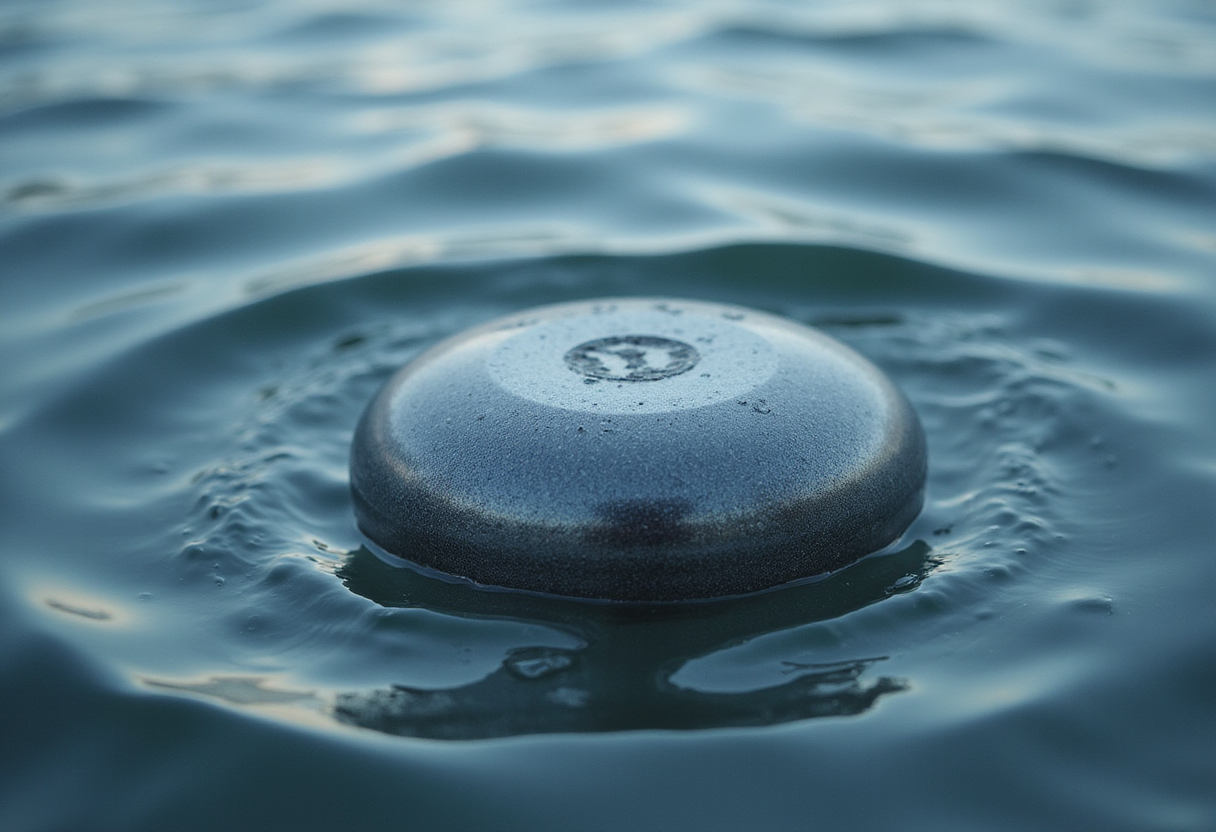
A hybrid titanium–polyurethane metamaterial developed at RMIT University in Melbourne lost only 0.15% of its mass during a two-week immersion in natural seawater at a measured density of 1.03 g/cm³, the team reports. Foam-filled hollow-strut lattices (HSLs) of Ti-6Al-4V titanium alloy stayed buoyant; unfilled control samples sank.
Lead author Ma Qian, a materials engineer at RMIT's Centre for Additive Manufacturing, frames the result as a step beyond Archimedes. "The innovation opens a new design space for marine structures, vehicles and rescue equipment where we need strength, low weight and buoyancy all at the same time," he said.
The work, co-led with the Conservatoire National des Arts et Métiers (CNAM) in France and published in Advanced Materials (DOI: 10.1002/adma.74641), targets a long-standing limitation of open-cell metallic lattices. Their interconnected pores flood with water, dragging the bulk density of even lightweight architected metals above that of seawater. The team's answer is a specific class of architected metal called a hollow-strut lattice, in which millimetre- and sub-millimetre-scale channels run through every strut.
What changes about buoyancy calculations?
Conventional analyses use bulk density (ρ_bulk), averaged across solid and pore volumes. Qian's group introduces a "skeletal density" (ρ_skeletal) that counts only the water-excluding portions of the lattice. When ρ_skeletal falls below the surrounding fluid, the structure floats even with all open pores flooded. The reframing shifts the engineering problem from fluid mechanics to material selection, which design teams can address inside CAD.
The prototype is a Ti-6Al-4V HSL produced via laser powder-bed fusion, then injected with expandable polyurethane foam at 0.08–0.11 g/cm³. Cross-section microscopy showed continuous, defect-free bonding between foam and strut wall, with foam pores spanning roughly 10 to 200 µm. The closed-cell foam limits water ingress while the surrounding open-cell architecture stays permeable, which Qian says preserves buoyancy "without notable density gain."
What did the immersion trials show?
Questions about long-term durability drove the test programme:
- Freshwater immersion (measured 0.997 g/cm³), more than two months: unfilled HSLs of every strut diameter tested sank; hybrid HSLs floated throughout the window.
- Natural seawater (measured 1.03 g/cm³), two weeks: hybrid HSLs remained afloat while losing approximately 0.15% of starting mass, indicating limited corrosion over the measurement period.
- Mechanical benchmark: foam-filled HSLs exceeded the specific strength of high-density polyethylene and 316L stainless steel, the two marine materials the authors selected as reference points.
That combination — high specific strength plus positive buoyancy without hermetic seals — distinguishes the architecture from conventional marine composites, which typically trade weight for water-tightness. Open-cell permeability also lets the lattice drain, refloat after capsizing, and tolerate pressure differentials that would buckle a closed shell.
What is the commercial path?
RMIT plans to validate the platform at component scale for "autonomous underwater vehicles and floating platforms," Qian told Physics World, alongside extended trials covering wave loading, biofouling and cyclic fatigue. The group is also evaluating non-marine pairings: a biodegradable magnesium scaffold filled with a growth-factor hydrogel for bone regeneration, and carbon-fibre-reinforced polymers occupying the strut channels of aerospace lattices.
On the manufacturing side, foam injection adds one post-processing step and a few hundred grams of consumable per cubic decimetre of lattice. The team has not yet published cost figures. The Centre for Additive Manufacturing is courting industrial partners and will introduce the design concepts into RMIT's advanced manufacturing curriculum for the next student intake.
The named project team is Andrey Molotnikov, Ma Qian, Milan Brandt, Jordan Noronha and Martin Leary. Funding sources and IP status were not disclosed in the Advanced Materials paper, and the CNAM collaborators were not named in the press materials reviewed.
via rmit.edu.au (Original)
Filed under
- additive-manufacturing
- titanium-alloys
- metamaterials
- marine-engineering
- architected-materials
More from Rebecca Stone
Show full bio
Market editor covering marketplaces and e-commerce at Hypothesis Wire.
183 articles
References
- In-situ XAS decodes activity-durability trade-off in MXene-supported Pt alloys
- Sandia develops microwave process for spent battery cathode upcycling
- Fraunhofer IFAM Opens Electrolysis Prototype Centre
- ORNL, INL partner to 3D-print and AI-qualify nuclear pressure vessels
- Sandia turns to microwave chemistry to recover battery metals