Proceedings · Session S-748 · filed October 3, 2026
Research InfrastructureSession paper
Fraunhofer IFAM Opens Electrolysis Prototype Centre
Fraunhofer IFAM has opened an electrolysis prototype centre to bridge lab-scale materials work and industrial stack manufacturing. Investment, capacity and test-stand specifications remain undisclosed.
By Rebecca Stone3 min read590 words
Summary
- Fraunhofer IFAM has opened a dedicated electrolysis prototype centre, announced via fuelcellsworks.com.
- The initial announcement discloses no investment figure, floor area, test-stand capacity or target stack power class.
- The facility positions the institute's materials and manufacturing-process expertise for industrial-scale electrolyser component development.
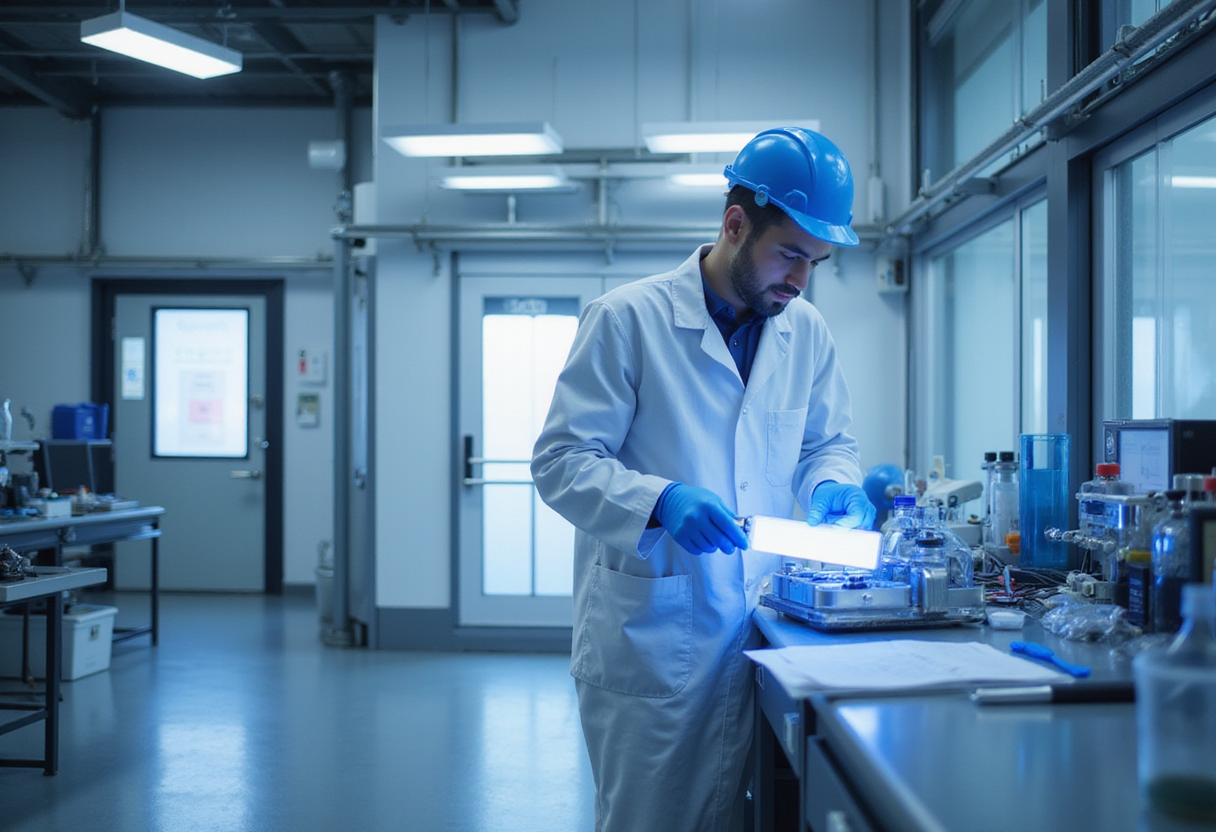
Fraunhofer IFAM has opened a dedicated electrolysis prototype centre, the institute announced via fuelcellsworks.com. The facility gives the Dresden-based materials research institute a staging ground for moving water-electrolysis technology out of laboratory cells and into components sized for industrial hydrogen production.
The centre addresses a bottleneck that R&D managers in the hydrogen sector know well. Most electrolyser innovations — new catalyst coatings, reduced precious-metal loadings, alternative stack materials — validate at the square-centimetre scale. Bridging to the square-metre scale required by commercial stacks demands pilot infrastructure that few academic groups can fund and few corporate labs can justify for exploratory work. Prototype centres of this kind sit in that gap.
Fraunhofer IFAM brings a specific competence profile to the task. The institute's core business is materials and manufacturing process development, including powder metallurgy, surface engineering and adhesive bonding. In the electrolyser context, that translates to work on porous transport layers, coated bipolar plates, joining technologies for stack assemblies and production processes that can survive transfer to high-volume manufacturing. A prototype centre lets the institute test whether material advances hold up when fabricated at component scale rather than coupon scale.
The announcement did not specify the centre's investment value, floor area, test-stand capacity or target stack power class. Those numbers matter for organisations deciding whether to partner with the facility or benchmark it against alternatives such as the Fraunhofer electrolysis activities at ISE in Freiburg, which has operated pilot-scale stack development for years, or the HyCentA and Helmholtz-centre test infrastructures elsewhere in Germany and Austria. Procurement and collaboration decisions will hinge on measured capabilities — pressure ratings, current densities achievable on the test stands, and the range of electrolyser chemistries served — none of which appear in the initial release.
The opening lands in a German hydrogen R&D market that has contracted from its 2021-2022 funding peak, with the National Hydrogen Strategy's second revision trimming some programme lines even as the EU's IPCEI Hydrogen wave 2 projects move from planning into execution. For vendors and research groups holding IPCEI work packages that require validated pilot-scale results, an additional German prototype facility with open access could shorten the queue for stack-scale testing.
For corporate R&D planners, the practical questions are concrete. Does the centre accept contract development work, and on what timeline? Will it run customer materials on its stands under confidentiality? And will it publish baseline performance data for its infrastructure, which would let partners estimate how results obtained there translate to their own platforms? Institute-run pilot facilities typically answer yes to the first two; the third varies.
The centre also signals where Fraunhofer sees demand. Opening a prototype facility commits multi-year operating budget to a hypothesis: that German and European industry will need scale-up support for electrolyser manufacturing faster than existing infrastructure can supply it. That bet is consistent with the EU's stated target of 100 GW of domestic electrolyser manufacturing capacity by 2030, though whether deployment demand materialises at that pace remains contested among market analysts.
Fraunhofer IFAM has not yet published a technical programme or opening schedule for the centre. Researchers and R&D managers seeking collaboration terms will need to contact the institute directly; the initial announcement provides the facility's existence and purpose but not its operational detail. Expect the centre's first published projects — and the measured performance figures that come with them — to indicate its actual position in the European electrolysis scale-up chain.
via Google News: Research infrastructure & national labs (Source)
Filed under
- fraunhofer-ifam
- electrolysis
- hydrogen
- pilot-scale-testing
- scale-up-manufacturing
More from Rebecca Stone
Show full bio
Market editor covering marketplaces and e-commerce at Hypothesis Wire.
80 articles
References
- DOE Hydrogen Office Widens University Funding, Adds Lab Projects
- In-situ XAS decodes activity-durability trade-off in MXene-supported Pt alloys
- ISS National Lab doubles down on Orbital Edge accelerator model
- Sandia Picks EEI to Lead National LDES Commercialization Push
- 12.5 bar of stack pressure doubled EV battery lifetime in Cambridge study