Proceedings · Session S-245 · filed October 1, 2026
Physical Sciences ResearchSession paper
Edinburgh's Quantum Software Lab secures £20m to build UK quantum advantage
Edinburgh's Quantum Software Lab will lead QATCH, a £20m, four-year UK programme to deliver tools and systems for evidenced quantum computing impact across vendor testbeds.
By Rebecca Stone4 min read804 words
Summary
- The UK government is providing £20m over four years for QATCH, a quantum software delivery programme led by the Quantum Software Lab at the University of Edinburgh.
- Since launching in 2023 with about 15 members, the QSL has grown to almost 100 researchers and works directly with seven NQCC testbed platforms spanning all leading qubit modalities.
- The 2025 Quantum Fringe festival ran 16 events, including TartanQEC, which drew over 120 researchers on quantum error correction with a keynote by ETH Zürich's Andreas Wallraff.
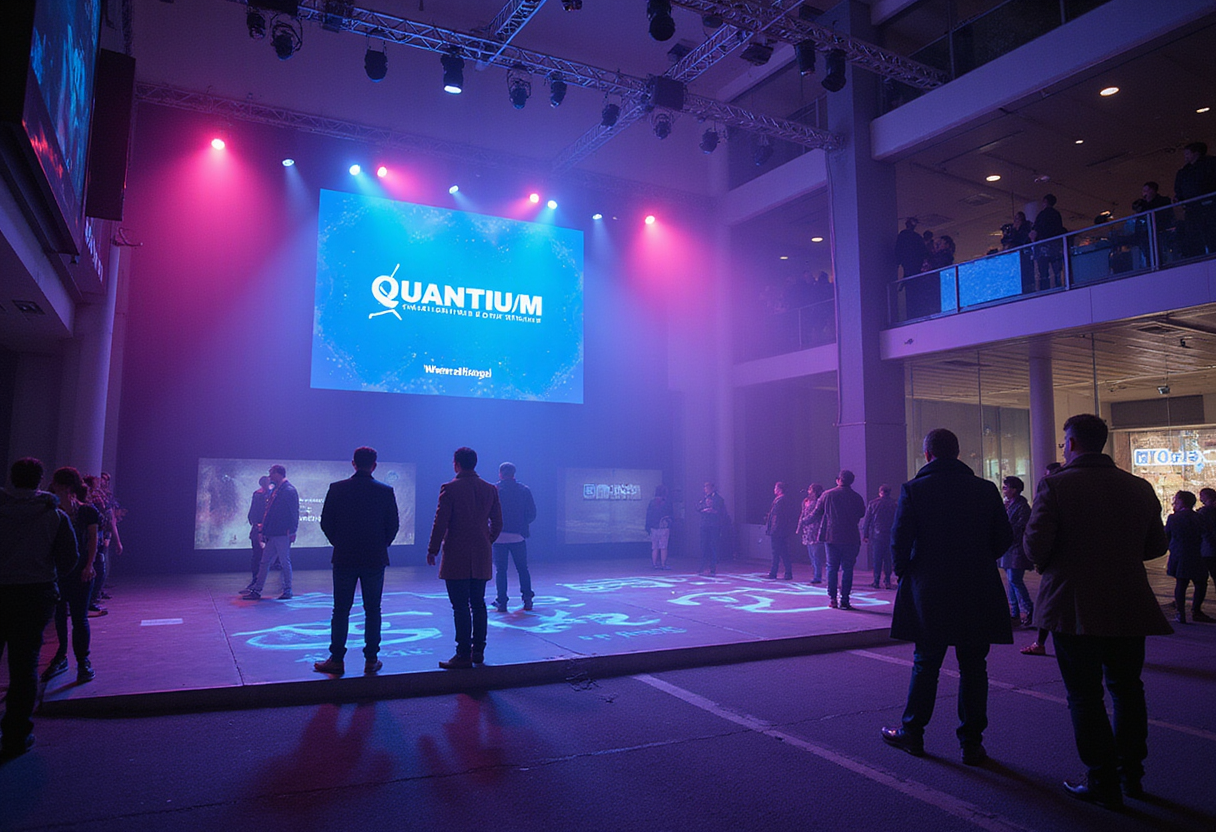
The UK government has committed £20m over four years to a new research programme led by the Quantum Software Lab (QSL) at the University of Edinburgh, with a mandate to move beyond exploratory work and deliver tools, methods and systems that produce evidenced impact from quantum computing.
The programme, called QATCH (Quantum Advantage TurboCHarger), builds on three years of QSL operations. Launched in 2023 with roughly 15 members, the lab now employs almost 100 researchers spanning foundational theory, algorithms and applications. Its strategic partnership with the UK's National Quantum Computing Centre (NQCC) gives its software specialists direct access to seven testbed platforms covering all the leading qubit modalities.
"Quantum computing is almost always told as a hardware story, but a machine only matters if it can give you an answer that is useful and that can be trusted," says Elham Kashefi, Director of the QSL and Chief Scientist of the NQCC. "That is a software problem."
The lab's operating model — pairing algorithm developers with hardware vendors — has already produced concrete results. PhD student Mario Herrero Gonzáles is using a hybrid quantum machine learning approach, training a model on a classical computer and generating samples on a quantum machine. Working with Infleqtion's neutral-atom platform, he recompiled the quantum programme to exploit the system's gate fidelity and connectivity.
"The Infleqtion team helped Mario to understand the timings of the gate operations and the sources of errors," explains Caitlin Jones, a senior QSL researcher. "That allowed him to reduce the noise by recompiling the programme to exploit the gate fidelity and connectivity offered by neutral-atom systems."
A second project, led by Leo Monbroussou, targets classically hard sampling on photonic platforms. The team works directly with two testbed providers, ORCA Computing and Aegiq, whose systems differ in architecture and control mechanisms. "Having a direct dialogue with the hardware experts has really helped to push the research forwards," says Jones.
QATCH marks a shift in emphasis. The first three years explored potential routes to quantum advantage; the new programme commits to delivering them. "The QATCH programme will launch the UK's first full-stack feedback loop, serving as the software engine that translates fundamental theory into verified applications," says Kashefi. "Through daily co-creation between our researchers, hardware vendors, and industry end-users on the national testbeds, we are ensuring that software actively drives forward the design and utility of these new quantum machines."
For R&D managers, the practical payoff is cross-platform capability. "QATCH gives us more runway to design more ambitious experiments, such as developing code that will run on different hardware devices for cross-platform benchmarking and optimisation," says Jones.
The announcement coincided with the Quantum Fringe, a festival that debuted in 2025 to mark UNESCO's International Year of Quantum Science and Technology and is modelled on Edinburgh's famous arts Fringe. This year's edition ran 16 events convened by different organisations.
"The Quantum Fringe belongs to everyone who takes part, whether they are researchers, scientists in government and industry, or students at university or school," says Kashefi. "That's the whole point: no-one can do this alone, and each of the 16 events in this year's festival provided an opportunity for the community to come together."
Technical content dominated. The TartanQEC workshop, organised by the Universities of Edinburgh and Strathclyde, drew more than 120 researchers from the UK and Europe to discuss practical quantum error correction methods, with a keynote on QEC schemes for superconducting quantum computers by Andreas Wallraff of ETH Zürich. A two-day event run by the Integrated Quantum Networks (IQN) hub addressed authentication requirements for securing future quantum communications, while the QCi3 hub convened academics and industry experts on quantum computing applications in defence.
QSL itself brought hardware vendors and researchers together to discuss scalable frameworks for verifying and benchmarking rapidly evolving architectures — a pressing problem for anyone making procurement decisions in this market. The regular AIMday matched companies of all sizes with academics on industry-relevant challenges; this year's event was the largest yet, with more than 60 participants tackling problems such as using quantum optimisation to design a multi-hub logistics network for the UK.
Around 170 people from across the quantum ecosystem attended the QSL's third annual showcase. The festival was supported by the NQCC, Infleqtion, Quantinuum, Riverlane, Classiq, IBM, the Institute of Physics, the National Physical Laboratory and Nu Quantum, with input from Edinburgh Innovations, the Centre of Doctoral Training in Quantum Informatics, the QCi3 and IQN hubs, the Quantum Software Alliance and the Quantum Computing Application Cluster.
With £20m in government backing, seven testbed platforms and a delivery-focused mandate, the QSL enters its fourth year positioned to make cross-platform quantum software tooling a measurable — rather than projected — outcome for UK industry.
via Physics World (Source)
Filed under
- quantum-computing
- uk-research-funding
- university-of-edinburgh
- nqcc
- quantum-software
More from Rebecca Stone
Show full bio
Market editor covering marketplaces and e-commerce at Hypothesis Wire.
80 articles
References
- Infleqtion Expands Superstaq Reach Across Three DOE Labs
- Q/C Technologies and Sandia National Laboratories Launch Research Collaboration
- IBM Commits Over $10 Billion to Fund Fault-Tolerant Quantum Roadmap
- Q/C Technologies Partners with Sandia National Laboratories
- Sandia and Quantinuum Validate 98-Qubit Helios Trapped-Ion System