Proceedings · Session S-111 · filed September 30, 2026
Physical Sciences ResearchSession paper
Sliding water droplets corrode Teflon-coated copper, Max Planck team finds
Max Planck researchers show droplets charged past 1 kV punch through 60 nm Teflon on copper after ~3000 impacts, adding electrochemistry to corrosion models.
By Rebecca Stone4 min read720 words
Summary
- Water droplets sliding down insulating surfaces acquired potentials exceeding 1 kV and corroded 60 nm Teflon coatings on copper after ~3000 impacts.
- Directly deposited droplets caused no corrosion; only droplets pre-charged by sliding on plant leaves, PVC or PFOTS coatings damaged the surface.
- Butt cautions that industrial coatings of ~100 microns are likely too thick for the effect; monument and heritage degradation is the likelier application.
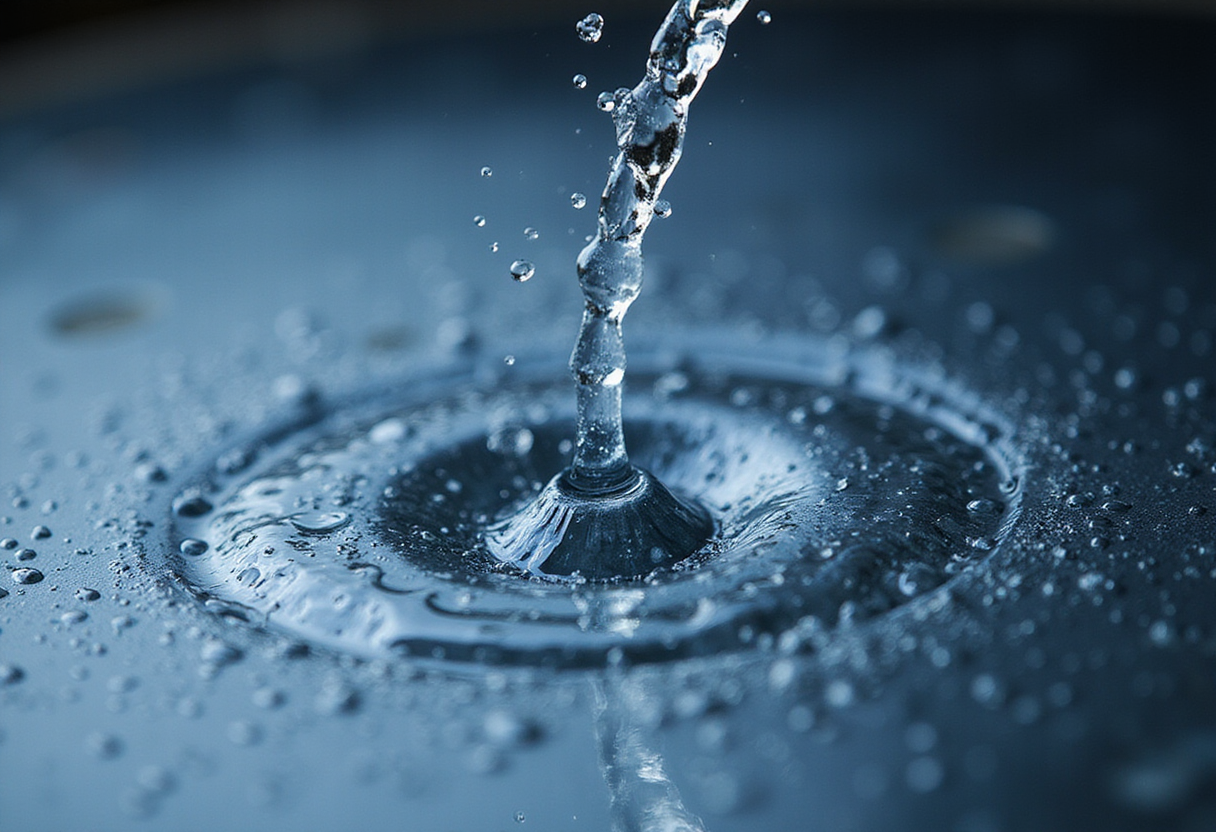
Water droplets sliding down insulating surfaces can carry potentials exceeding 1 kV and corrode Teflon-coated copper when they discharge onto it. That is the measured result from Hans-Jürgen Butt's group at the Max Planck Institute for Polymer Research in Mainz, published in Nature. The finding adds an electrochemical mechanism to a corrosion field that has long attributed droplet damage to abrasion and pollutant chemistry alone.
The experiments are concrete. The researchers deposited water droplets onto copper surfaces coated with 60 nm of Teflon. Droplets released directly onto the coating produced no corrosion. Droplets first run down sloped insulating materials — plant leaves, PVC construction boards and the perfluorooctadecyltrichlorosilane (PFOTS) hydrophobic coating commonly applied to window glass — then allowed to fall onto the coated copper told a different story. After roughly 3000 droplet impacts, atomic force microscopy and confocal microscopy revealed corrosion of both the Teflon coating and the copper underneath.
The proposed mechanism: droplets acquire positive charge as they slide, and the potential difference at the coating exceeds its dielectric breakdown strength. The droplet discharges, damaging the coating and exposing the metal to further oxidation. Two independent measurements support the hypothesis. Charge-movement measurements in the copper showed negative charge flowing toward droplets dripping off insulating surfaces. High-speed camera footage showed that a directly deposited drop retains its spherical shape before impact, while a dripping drop stretches into a cone — concentrating positive charge at a tip that raises its corrosive capacity.
The result overturns a long-standing assumption. "If you have a solid and you rub another insulating solid against it you get electron transfer — I think this has been known for more than 2500 years," says Butt. But triboelectric charging was thought impossible in liquids, because liquids lack the atomic-scale surface roughness that concentrates charge at points where bonds can break. The mechanical force of surface tension alone, Butt notes, is far too low to drive electron or ion transfer onto a surface. Only in the past decade has evidence accumulated that sliding droplets become highly charged — a shift Butt credits with making this work possible.
For R&D managers, the immediate practical scope is narrower than the headline suggests. Butt is explicit about the limits. "Technical coatings on cars, ships etc. are typically 100 microns and thicker, so the process we describe is probably not of direct relevance," he says. A 60 nm laboratory coating and a 100 μm industrial coating differ by three orders of magnitude, and the paper does not test whether breakdown-driven damage scales to thicker barriers. Where the mechanism may matter is in degradation of monuments and other outdoor heritage objects, where thin surface layers and repeated droplet exposure combine. "We have evidence that surfaces change their properties when you slide charges over them, but the real consequences are not yet known," Butt cautions.
The underlying physics also remains unresolved. "We still don't know why the heck there is such a charge separation: it's energetically unfavourable, it should not happen, but it happens," says Butt. "The one effect we describe here is, in a way, pretty trivial — everyone knows that if you have a high potential and it's somehow grounded there is a breakthrough — but what happens at the surface with this deposited charge is not clear."
Independent commentary frames the result within an emerging field. Zhong Lin Wang of Georgia Institute of Technology, who helped discover the triboelectric effect in liquids and develop the triboelectric nanogenerator used to quantify it, points to contact-electro-catalysis — first proposed in 2022 and now an active research area in chemistry, materials and environmental science — in which transferred electrons return to the water and drive reactions at nearby surfaces. "[Butt and colleagues] show that the electrons transferred from the water droplet can 'break' the surface coating layer and lead to local oxidation," Wang says. "This is an interesting discovery."
The work separates what was measured — charge transfer, kilovolt-scale potentials, coating and copper damage after ~3000 impacts on 60 nm films — from what remains projection, namely relevance to real-world coatings and heritage materials. Butt says his group remains focused on the fundamental physics of charge separation rather than applied mitigation, so any corrosion-prevention payoff will depend on follow-on work by others in coatings and conservation research.
via mpip-mainz.mpg.de (Original)
Filed under
- corrosion
- triboelectricity
- max-planck-institute
- coatings
- surface-science
More from Rebecca Stone
Show full bio
Market editor covering marketplaces and e-commerce at Hypothesis Wire.
80 articles
References
- Fraunhofer IFAM Opens Electrolysis Prototype Centre
- X-ray imaging catches oxide coatings halving graphene fields
- In-situ XAS decodes activity-durability trade-off in MXene-supported Pt alloys
- Six of 79 Collisions: Graz Team Maps the 'Cone of Reaction'
- Applied Voltage Switches Exciton Transport in 2D Perovskite-WS2 Device