Proceedings · Session S-425 · filed September 30, 2026
Physical Sciences ResearchSession paper
TMT Rejects Spain's €1bn La Palma Offer, Leaving Only Mauna Kea
TMT partners rejected Spain's €1bn La Palma package, leaving Mauna Kea as the sole site option for the $3bn telescope still $1bn short of committed funds.
By Amara Osei2 min read466 words
Summary
- TMT International Organization members rejected Spain's €1bn package (€400m membership plus €600m in EIB and ICO loans) for La Palma, leaving Mauna Kea as the only possible site.
- Construction is expected to cost at least $3bn, with $2bn committed; the NSF chose in 2025 to back the rival Giant Magellan Telescope instead.
- The telescope design calls for 492 zero-expansion glass segments forming a 30 m primary mirror to resolve the faintest, oldest galaxies.
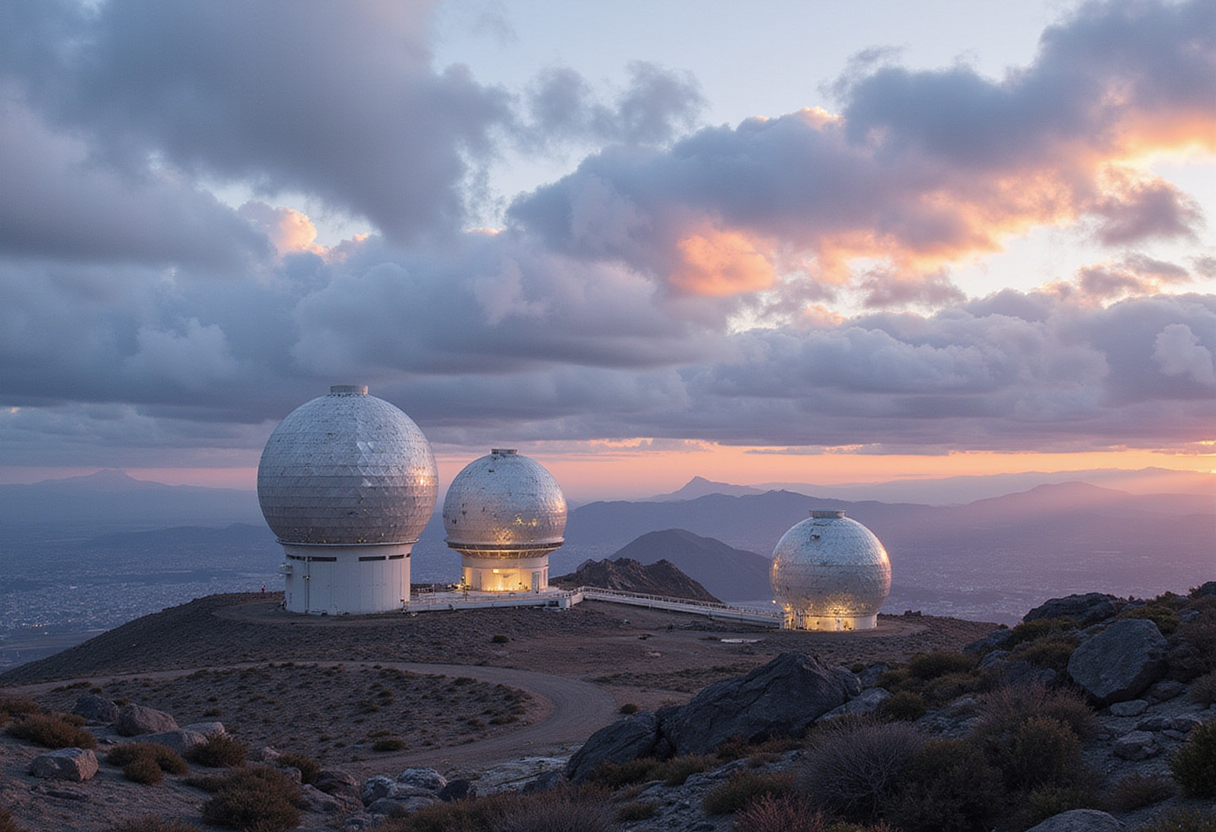
The Thirty Meter Telescope (TMT) International Organization has rejected Spain's €1bn package to host the instrument at the Roque de los Muchachos Observatory on La Palma, a decision that leaves Hawaii's Mauna Kea as the only remaining option for the $3bn-class project.
Spain tabled the offer in July 2025, combining a €400m commitment to join the project — contingent on construction in La Palma — with €600m in loans from the European Investment Bank and Spain's Official Credit Institute. According to a statement from the Astrophysics Institute of the Canaries (IAC), which operates the observatory, TMT members were "unable to reach the consensus required to accept the financial offer."
The IAC says it "remains fully committed to the scientific and technological development of the [Roque de los Muchachos Observatory]" and will continue pursuing new infrastructure there, including the Cherenkov Telescope Array Observatory and the European Solar Telescope.
The technical case against La Palma
The rejection closes a chapter that opened in 2016, when project officials designated La Palma as their preferred backup after protests by indigenous Hawaiians, who regard Mauna Kea as sacred, halted construction in 2015. The TMT organization had originally selected Mauna Kea in 2009.
Astronomers had flagged scientific risks in the potential move throughout. La Palma sits at a lower elevation and a warmer latitude than Mauna Kea, and mid-infrared observations — a key capability for the instrument — require dry, cool conditions. The site's climate could therefore have constrained the telescope's scientific return regardless of the financing on offer.
That capability rests on ambitious hardware: a segmented primary mirror of 492 zero-expansion glass elements forming a 30 m aperture, designed to resolve the faintest and oldest galaxies.
Budget position and the GMT rivalry
TMT officials have not released a final construction cost, but the figure is expected to be at least $3bn, of which $2bn has been committed. The consortium includes the University of California, the California Institute of Technology, Canada, India and Japan.
The funding gap has widened in the face of US policy. In 2024 the National Science Foundation announced it would support construction of only one of the two competing US extremely large telescope projects — the TMT or the Giant Magellan Telescope (GMT) — not both. A year later, the NSF chose to pursue the GMT, which combines seven primary and seven secondary mirrors for a 25.4 m optical surface. GMT construction is already under way at Las Campanas in Chile, with officials working toward a final design review.
The rejection of Spain's offer removes the last alternative to Mauna Kea, a site where the project still faces opposition and unresolved access questions. TMT now must close a funding shortfall without a European fallback, while its principal US rival advances through construction in Chile.
via tmt.org (Original)
Filed under
- thirty-meter-telescope
- astronomy
- mauna-kea
- la-palma
- nsf
More from Amara Osei
References
- Italy and Germany Sign Agreement to Develop Einstein Telescope
- NASA's $4.3bn Roman Telescope Reaches for the Dark Universe
- Sandia Picks EEI to Lead National LDES Commercialization Push
- Off-the-Shelf Thermal Cameras Tackle LIGO's Mirror Noise Problem
- Q/C Technologies Partners with Sandia National Laboratories