Proceedings · Session S-461 · filed September 30, 2026
Research InfrastructureSession paper
NASA's $4.3bn Roman Telescope Reaches for the Dark Universe
The $4.3bn observatory launched on 30 August will survey the sky 100 times wider than Hubble's view, generate 1.4 zettabytes daily and hunt dark energy, dark matter and exoplanets.
By Priya Raman4 min read703 words
Summary
- NASA launched the $4.3bn Nancy Grace Roman Space Telescope on a SpaceX Falcon Heavy from Kennedy Space Center at 7:26 a.m. local time on 30 August.
- The telescope's field of view is at least 100 times greater than Hubble's, and it will generate 1.4 zettabytes (1.4 billion terabytes) of data daily — the highest rate of any NASA astrophysics mission.
- Three surveys in the first five years target tens of thousands of supernovae, more than a billion galaxies and over 2,000 exoplanets found via microlensing toward the Milky Way's centre.
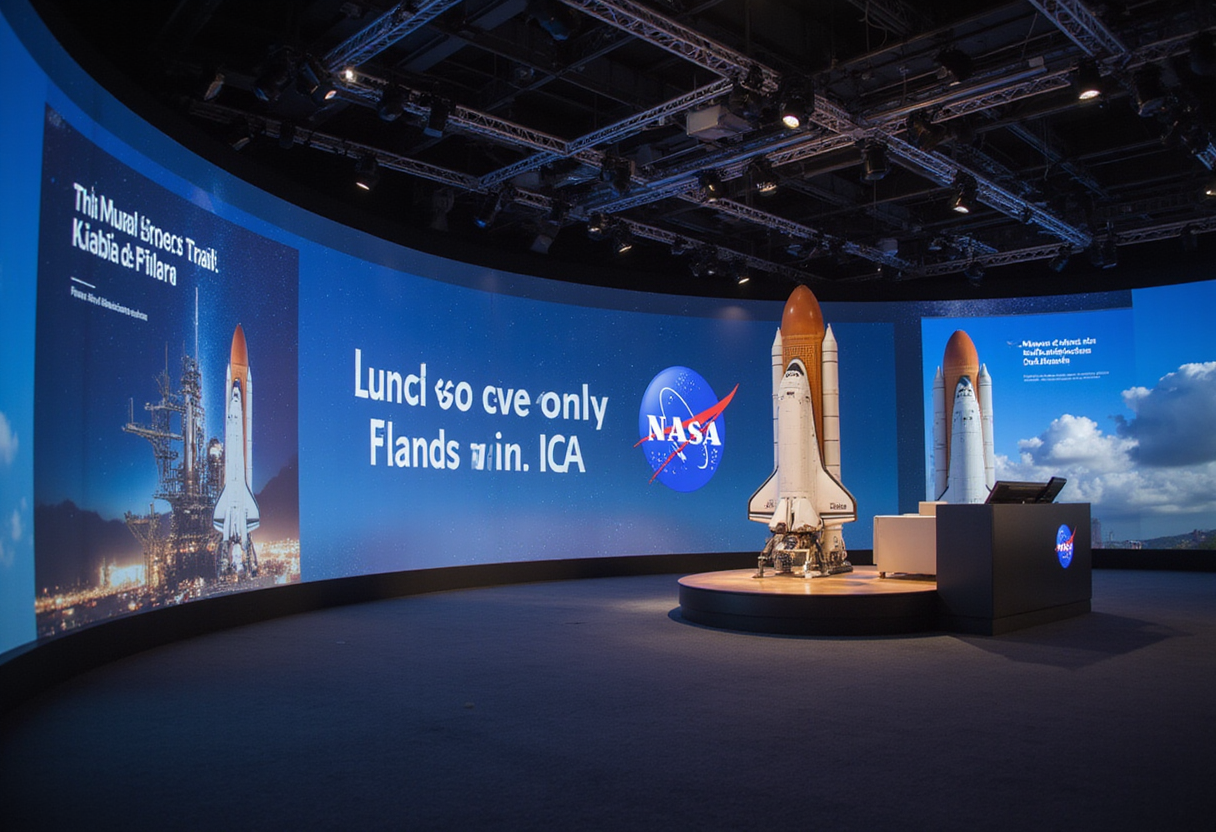
NASA has launched the $4.3bn Nancy Grace Roman Space Telescope, putting into orbit an observatory designed to survey the sky a thousand times faster than Hubble and to produce 1.4 billion terabytes of data every day — the highest data rate of any NASA astrophysics mission to date.
The spacecraft lifted off on a SpaceX Falcon Heavy from Florida's Kennedy Space Center at 7:26 a.m. local time on 30 August. It will spend three months cruising to the second Sun–Earth Lagrange point (L2), about 1.6 million kilometres from Earth, before beginning a mission intended to run for at least a decade.
For research managers and instrument teams, the mission's headline specification is field of view: at least 100 times greater than that of the Hubble Space Telescope. The telescope carries a 2.4 m primary mirror — the same diameter as Hubble's — paired with two instruments. A wide-field instrument will image in visible and near-infrared light. An experimental coronagraph will use masks, prisms and mirrors to cancel out starlight, a technology demonstration aimed directly at exoplanet detection.
Three surveys in five years
NASA has planned three core surveys for the observatory's initial five years. The first will identify tens of thousands of distant supernovae — far exceeding the roughly 2,000 currently known. A second survey will observe more than a billion galaxies. Combined with data from other survey telescopes, both datasets will feed models of dark energy and its potential role in the accelerating expansion of the universe, while gravitational lensing measurements from the same observations will let astronomers map the distribution of dark matter.
A third survey will target the centre of the Milky Way, searching for gravitational microlensing signals expected to reveal more than 2,000 exoplanets that are otherwise invisible to direct observation.
Those numbers are projections, and NASA has not yet published detection-rate benchmarks from commissioning data. The mission's measured performance at L2 — throughput, pointing stability, coronagraph contrast — will determine whether the survey targets hold. What is firm is the engineering envelope: the observatory's daily output of 1.4 zettabytes will require machine learning, artificial intelligence and what NASA calls "citizen science" to sift raw data and flag findings for astronomers to study in detail. For teams building pipelines around Roman's archive, that data rate sets the scale of the computational problem from day one.
Nicola Fox, associate director for NASA's Science Mission Directorate, framed the mission in ambitious terms. "Roman will be a discovery machine that will bring us closer than ever before to answering humanity's most profound questions about our cosmic history," she said.
Budget history and programme discipline
The programme has not followed a straight line. The observatory began life as the Wide-Field Infrared Survey Telescope and underwent several design changes under cost pressure before NASA renamed it in 2020 after Nancy Grace Roman (1925–2018), who became the agency's first chief astronomer in the early 1960s and is widely known as "the mother of the Hubble Space Telescope."
NASA administrator Jared Isaacman praised the launch as "exactly the kind of success story we want to see," noting that the mission was completed "ahead of schedule and on budget" and that it "will demonstrate what is possible when America's space programme pairs bold ambition with disciplined execution." Those claims come from the agency itself; independent cost verification has not accompanied the announcement.
Complement, not replacement
Roman will not replace Hubble or the James Webb Space Telescope. Its role is complementary: it will scan wide areas of the sky, and the two narrower-field observatories can then follow up targets of interest at higher detail. That division of labour mirrors how survey instruments and targeted telescopes already share work across ground- and space-based portfolios, and it positions Roman as a discovery engine feeding observation queues for years to come.
The next concrete milestone is arrival at L2 in late November, followed by commissioning of the wide-field instrument and the coronagraph. First survey data — and the first test of whether the 1.4-zettabyte daily pipeline performs as designed — should follow in the mission's opening year.
via nasa.gov (Original)
Filed under
- nasa
- roman-space-telescope
- astronomy
- dark-energy
- space-telescopes
More from Priya Raman
References
- TMT Rejects Spain's €1bn La Palma Offer, Leaving Only Mauna Kea
- Off-the-Shelf Thermal Cameras Tackle LIGO's Mirror Noise Problem
- Italy and Germany Sign Agreement to Develop Einstein Telescope
- NASA Bets on Compact Lab Hardware to Reshape Research Workflow
- EU pushes training for next-generation research infrastructure staff