Proceedings · Session S-405 · filed November 9, 2026
AI & Emerging Tech in R&DSession paper
Lingyi robot completes Mount Taishan climb in 43 minutes, 41 seconds
Lingyi Technology, a Unitree subsidiary, posted the official Mount Taishan climb in 43:41; UNIUBI AI’s smaller Cyvet recorded 35:47 on a trial course.
By Sophie Lindqvist5 min read939 words
Summary
- On November 2, with no year stated, nearly 90 teams took part in the first World Robot Mount Taishan Climbing Competition in Tai'an, Shandong.
- The 3.9 km official route rose about 600 m; the best robots finished in under 60 minutes.
- Lingyi Technology, a Unitree subsidiary, recorded the fastest reported official time of 43 minutes and 41 seconds.
- UNIUBI AI's Cyvet logged 35 minutes and 47 seconds in a trial from Hongmen to Zhongtianmen using LiDAR and real-time 3D mapping.
- Global Times reported more than 400 humanoid models in production and more than 40,000 units rolled out in the first half of 2026.
By Sophie Lindqvist
A four-legged robot from Beijing-based Lingyi Technology, a subsidiary of Hangzhou-based Unitree Robotics, completed the official Mount Taishan course in 43 minutes and 41 seconds, the fastest mark reported for the first World Robot Mount Taishan Climbing Competition.
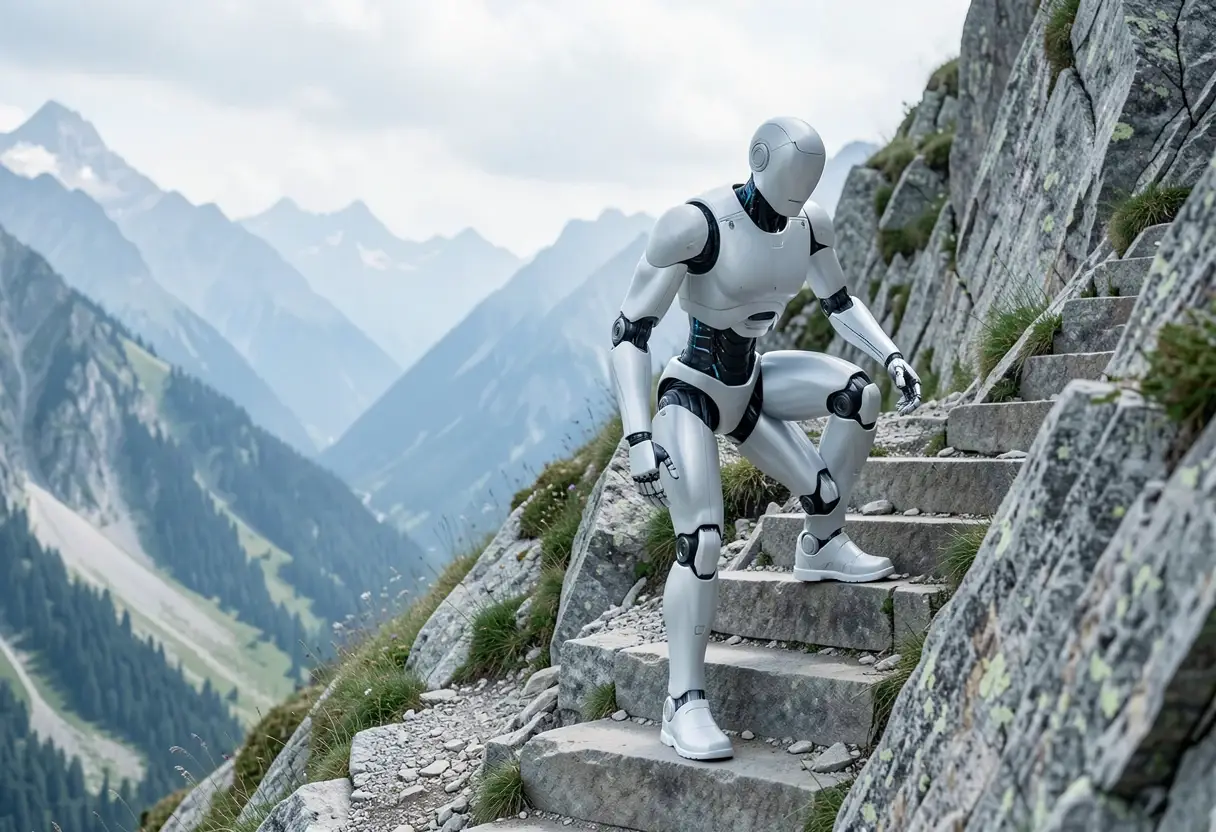
The November 2 event in Tai'an, Shandong, drew nearly 90 robot-making teams, according to Global Times. Humanoids, robot dogs and other locomotion systems tackled a 3.9 km (2.4-mile) route that rose about 600 m (0.37 miles) and crossed more than 3,000 uneven stone steps.
An average hiker would need one to two hours; the best bots finished in under 60 minutes.
What did the competition test?
The competition used four official events:
- Humanoid robots racing to the summit.
- Robots carrying loads up the mountain.
- An exoskeleton-assisted machine climbing the route.
- An all-terrain scouting challenge.
CCTV+ footage cited by Global Times showed robots climbing, pausing, recalculating and continuing with either careful or springy gaits. The course gave engineers a stress test for balance, obstacle adaptation and real-time control beyond the mostly level ground on which legged robots have done much of their development.
Where did the faster Cyvet time come from?
UNIUBI AI, a Beijing company, recorded 35 minutes and 47 seconds for its Cyvet robot dog on a trial run from Hongmen to Zhongtianmen. Cyvet was the smallest entrant, and its time was 7 minutes and 54 seconds faster than Lingyi's official 43:41 mark.
That trial result does not make Cyvet the official winner because Global Times did not show that organizers applied identical start, timing or validation rules to both runs. The report also omits battery state, payload, and failure or human-intervention counts, leaving no basis for comparing endurance or autonomy.
The report says Cyvet used LiDAR and real-time 3D mapping to handle the uneven terrain. Chen Lin, a navigation engineer on the Hangzhou-based UNIUBI AI team, told CCTV: “Adapting to Mount Taishan’s road conditions was the biggest challenge.” He described steps built centuries ago, with high, low, wide, narrow and cobbled sections.
What can the published results establish?
Mount Taishan is the tallest peak in Shandong. Some routes exceed 7,000 steps, and even the simplest can take several hours, according to the source description. Its stone steps are sturdy but often uneven and centuries old, while handrails appear only intermittently.
The report documents a competition rather than a controlled field trial. It gives no exact team count beyond “nearly 90,” no category winners for all four events, and no independent timing method. It also provides no sensor ablation, so it cannot show whether LiDAR or 3D mapping alone produced Cyvet's performance.
The source headline refers to U.S. technology, but the report names no U.S. entrant or comparator.
For lab and portfolio managers, the unanswered engineering questions are specific: Can a taller biped maintain balance without a tether? Can a quadruped identify a failed foothold and recover without a remote operator? Can either carry a specified load over the same 600 m rise? The climb supplies demonstrations, but the published results cannot answer those procurement questions.
What does the event mean for investment and deployment?
Xiang Ligang, president of the Beijing Institute of Intelligent Era Industry, told Global Times: “Like the early exhibitions of aircraft and automobiles, robot sporting events can serve as visible indicators of technological maturity, attracting public attention while also drawing investment.”
That is an institute president's interpretation, not a measured investment result; the report cites no sponsorship amount, funding round, order or deployment contract.
For lab and portfolio managers, the relevant question is whether climbing performance transfers to the applications named in the report: rescue sites, hospitality, multilevel offices, factories and homes. Teams would need published specifications for reliability, payload and safe autonomy before a mountain result could justify deployment budgets.
Balance remains the central hurdle for taller bipedal humanoids, while autonomous recovery matters for quadrupeds. The mixed field also showed that locomotion developed on level ground can still break down on old, variable steps.
What do the reported production figures show?
Global Times reported that China's Ministry of Industry and Information Technology listed more than 400 different humanoid models in production and that rollout exceeded 40,000 units in the first half of 2026.
Those figures describe reported manufacturing scale, but the article provides no production list, delivery definition or breakdown by model, operator or use case. It also does not state the year of the November 2 contest, so it cannot establish whether the event preceded, coincided with or followed the reported first-half 2026 rollout.
How do human access and the downhill track compare?
Escalators, elevators and conveyor belts have become popular in recent years as ways to reach mountain views, including for people with less physical ability. That comparison sets a practical benchmark: robots must handle irregular steps without adding labor-intensive infrastructure or human assistance.
A separate 3.7 km (2.3-mile) downhill kart track at Gulong Gorge reaches a top speed of 30 km/h (18 mph) and now hosts real-life Mario Kart rides. The source says no robot has yet mastered that course and provides no robot trial data, so it remains a communication comparison rather than a benchmark.
The next decisive test would repeat a published route under identical timing and safety rules, with payload, power use, intervention rate and failure data attached; until then, the 43:41 official result shows capability, while the 35:47 trial shows why procurement teams should demand reproducible methods before scaling budgets.
via newatlas.com (Source)
Filed under
- legged-robots
- mount-taishan
- robot-competition
- lidar
- autonomous-navigation
More from Sophie Lindqvist
Show full bio
Correspondent covering money, funding and market shifts around research and development at Hypothesis Wire.
219 articles
References
- Hopcopter foot pad cuts cross-terrain performance variation by 84%
- RLWRLD hires IBM veteran as COO to scale robot foundation model
- Sandia completes final Mobile Guardian Transporter crash test
- Sandia tests reinforcement learning on cooperative drone evasion
- China's Biotechs Sell Speed: Abbisko Trial Finished in 11 Months