Proceedings · Session S-432 · filed November 9, 2026
Lab Technology & MethodsSession paper
Hopcopter foot pad cuts cross-terrain performance variation by 84%
A University of Toronto team added a wider, elastic, spiked foot pad to the Hopcopter, cutting performance variation by 84% across terrain. Commercial sale and AI obstacle avoidance remain ahead.
By Rebecca Stone4 min read840 words
Summary
- The new flexible foot pad reduced performance variation across different terrains by 84%.
- The creators report energy use at one-tenth that of a drone of the same size.
- Researchers announced the original Hopcopter prototype two years ago.
- Hopcopter uses four rotors and one spring-loaded landing leg.
- The redesigned pad combines a wider surface, three rubber bands and short spikes.
By Rebecca Stone
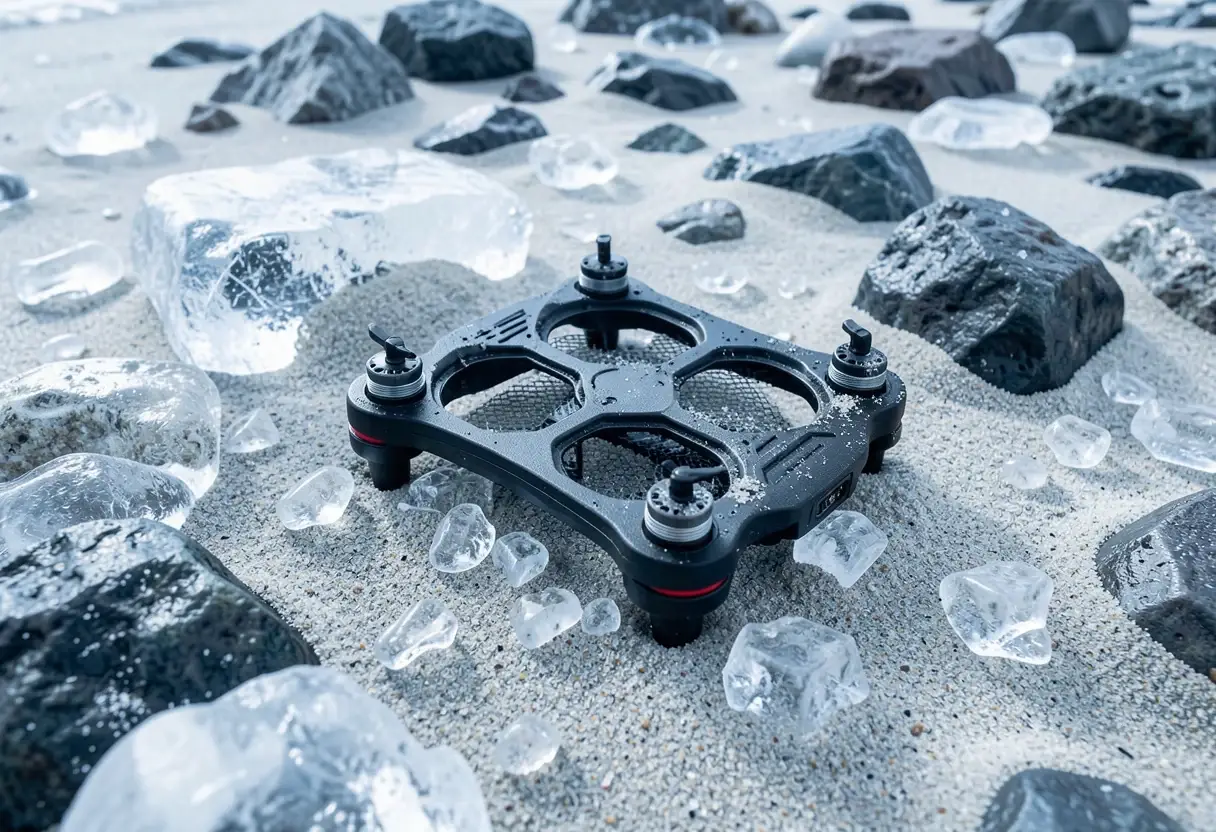
A flexible foot pad “reduced performance variation across different terrains by 84%,” according to the University of Toronto account of the Hopcopter study. Researchers linked that gain to more consistent landings on ice, sand and rocks, after the first prototype sank, slipped or toppled when the ground departed from flat, firm conditions.
What operating gap was Hopcopter built to close?
Robots already swim underwater, crawl through rubble or land on tree branches, but each approach occupies a specific operating mode. Wheeled and legged machines have difficulty with uneven terrain and may be stopped by stairs; flying drones ignore ground conditions but cannot carry much weight. The broader goal is access to places difficult for people to reach.
City University of Hong Kong and The Hong Kong University of Science and Technology developed Hopcopter as a quadcopter, meaning a drone with four rotors, fitted with one spring-loaded leg. The design draws on birds, which hop between locations rather than flying continuously and thereby conserve energy. Hopcopter hops between suitable locations but remains airborne when it cannot land.
Using the two modes could put the machine into places otherwise accessible only by airdrop. For an R&D team, the proposal is a power-management strategy: reserve continuous flight for sections where no suitable landing site exists.
How does the hopping cycle work?
During a hop, the robot enters a free fall and, while rising, engages all four rotors only briefly. The creators say this allows Hopcopter to cover quite long distances while using one-tenth the energy of a drone of the same size.
That energy figure matters for mission planning, but the university account gives no payload, meaning carried mass, battery capacity, travel distance, comparator-drone specification, test conditions or independent replication. The result is a creator-reported benchmark, not a standardized energy claim.
What failed in the first Hopcopter?
The current machine is the second version. Researchers announced the original prototype two years ago; it could land on its single leg on flat concrete and fine gravel, then push off toward the next point. It sank into sand, slipped on ice and often fell over on sloped surfaces.
Those failures made landings across mixed terrain unreliable and set three mechanical requirements for the redesign.
How does the flexible foot pad work?
University of Toronto research partners designed a flexible foot pad around those failure modes. Its geometry addresses penetration, recovery and traction in three separate parts:
- A wider surface distributes the robot’s weight more evenly, which reduces sinking into soft soil and sand.
- Three rubber bands provide enough tension to return the foot to its position after landing, helping the robot regain balance.
- Short spikes cover the bottom of the pad and grip slippery surfaces.
Those features target load spreading, elastic recovery after impact and traction on low-friction surfaces. The study reports one aggregate cross-terrain gain rather than separate performance figures for sand, ice, rock or slope.
How strong is the reported 84% result?
Researchers reported that the new pad reduced performance variation across different terrains by 84%. In plain terms, they said the robot now lands much more consistently while moving among complex surfaces such as ice, sand and rocks.
The account does not define the performance metric, identify the sample size or trial count, report uncertainty, or reproduce the baseline and test matrix. Laboratory teams therefore cannot determine how broadly the gain holds.
It is a measured comparative result, but the source gives no basis for projecting reliability on unlisted terrain or during operational use. For R&D planning, the 84% figure needs a protocol before it can support a design freeze or supplier comparison.
What remains before commercialization?
Some of the creators are working to commercialize the technology. They have not put a production version on sale, although the source says technical details appear on a company website; the account does not name that company. The team also plans a version with integrated artificial-intelligence modules for obstacle avoidance, meaning automatic detection and routing around obstructions.
The account provides no delivery date, price, production capacity, certification plan, funding disclosure or performance target for either step. Procurement teams therefore have no basis for budgeting or scheduling, while investors lack evidence of a near-term revenue path. The defensible status is a research prototype with a stated commercialization intention.
Which proposed uses have evidence behind them?
The research group hopes to use Hopcopter for search-and-rescue operations, inspections at remote mining sites and, possibly, exploration on other planets. A paper on the study has appeared in Advanced Intelligent Systems. The source gives no publication date, field-test location, operational deployment or mission result, so these applications remain objectives rather than demonstrated capabilities.
The next useful milestone for laboratory and mission planners is a reproducible field-test matrix with disclosed payload, energy measurement, landing-error statistics and obstacle-avoidance performance. Those data would determine whether Hopcopter should enter a funded rescue or mining pilot, rather than remain a mechanically promising test platform.
via newatlas.com (Source)
Filed under
- hopcopter
- robot-locomotion
- flexible-foot-pad
- cross-terrain-mobility
- energy-efficient-robotics
More from Rebecca Stone
Show full bio
Market editor covering regulation, policy and their impact on research and development at Hypothesis Wire.
245 articles
References
- Lingyi robot completes Mount Taishan climb in 43 minutes, 41 seconds
- Sandia tests reinforcement learning on cooperative drone evasion
- Sandia completes final Mobile Guardian Transporter crash test
- Kyushu team reports self-docking flexible circuits with sub-100 μm actuators
- HPE computer will run first LLMs on the moon aboard Astrolab rover