Proceedings
Corporate & Industrial R&DSession paper
Three Phase 3 Wins in 23 Days Leave Genmab With a China Supply Problem
Genmab's petosemtamab, Rina-S and epcoritamab trials cut death or progression risk by 50-71%, but Darzalex royalties fund 64% of revenue and Rina-S is manufactured in China under BIOSECURE.
By Rebecca Stone3 min read608 words
Summary
- Genmab reported three successful Phase 3 trials within 23 days in October 2026.
- Darzalex royalties supply about 64% of Genmab revenue; US patents expire in 2029.
- Genmab spent about $9.8 billion on Merus and ProfoundBio, funded partly by $5.5 billion in new debt; net profit fell 25% in the first nine months of 2026.
- Rina-S's contract manufacturer operates in China; the BIOSECURE Act became law in December 2025.
- US-listed shares closed at $50.60 on November 20 after a ~44% weekly gain in Copenhagen.
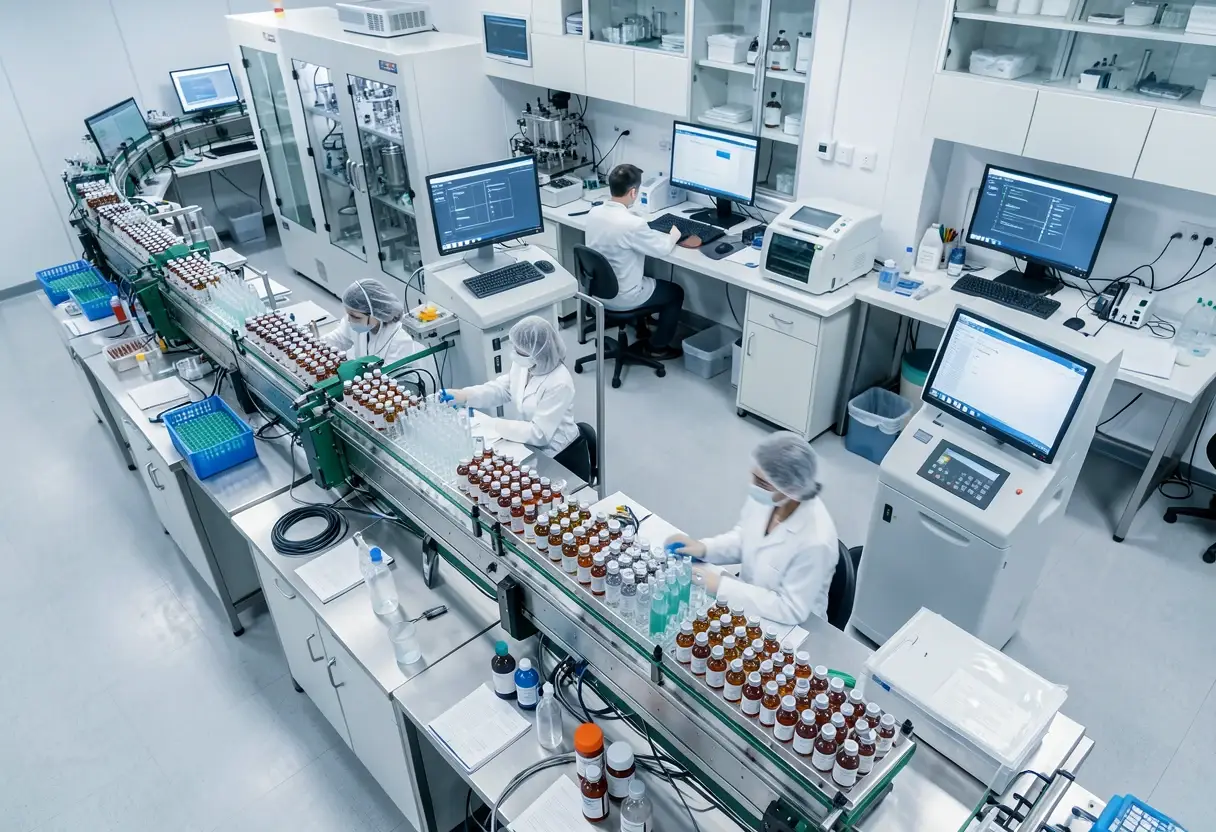
Genmab reported three successful Phase 3 trials within 23 days in October, and the numbers are unusually sharp: petosemtamab cut the risk of death by 50% in head and neck cancer, Rina-S cut progression risk by 71% in ovarian cancer, and epcoritamab cut progression risk by 51% in frontline lymphoma. The Copenhagen-listed shares gained about 44% in a single week, and the US-listed stock closed at $50.60 on November 20.
For R&D managers tracking Genmab (Nasdaq: GMAB), the clinical run answers one question and raises another. The biology now looks solid across three distinct programs. The open questions concern execution, and they carry hard deadlines.
Where does the money come from until 2029?
One drug still underwrites the pipeline. Royalties on Johnson & Johnson's Darzalex supply roughly 64% of Genmab's revenue, and the US patents on that product expire in 2029. To replace the income before the cliff, Genmab has already committed large capital:
- Acquisition of Merus for about $8.0 billion
- Acquisition of ProfoundBio for $1.8 billion
- Approximately $5.5 billion of new debt to fund part of the purchases
The debt is already visible in the accounts. Net profit fell 25% over the first nine months of 2026 even as revenue grew 22%. That spread — falling profit against rising sales — is the financial signature of a company mid-transition from a royalty house to a product company, and it defines the budget constraints under which the launch programs will be executed.
Why does manufacturing now matter?
The shift from royalties to products changes Genmab's exposure to geography. For two decades, royalty payments on Darzalex reached Genmab without any physical product crossing a border. Selling its own drugs ends that insulation.
Genmab's annual report states that the contract manufacturer for Rina-S, its lead wholly owned launch, operates in China. The BIOSECURE Act, which restricts US reliance on Chinese biomanufacturing, became law in December 2025. A US supply chain that intersects with restricted Chinese manufacturing capacity is now a regulatory matter rather than a procurement detail, and Rina-S is the company's most important wholly owned asset.
Securing alternative supply for Rina-S is therefore a first-order execution risk, not a secondary operational task.
What legal and political pressures sit on top?
Three separate frictions compound the manufacturing question:
- AbbVie co-sells Genmab's lymphoma drug, epcoritamab, while simultaneously suing Genmab over Rina-S — a partner in one program and an adversary in another.
- Denmark faced US tariff threats over Greenland in January, placing Genmab's home jurisdiction inside a live trade dispute.
- The petosemtamab patent is co-owned with Spanish research institutes and runs to an estimated 2038, adding a multi-party European ownership structure to the portfolio.
Genmab's own DuoBody platform, the antibody engineering technology underlying much of the pipeline, is protected by patents dating from 2010, which sets the horizon for the proprietary platform business.
How should R&D readers weigh this?
The measured results — the three Phase 3 risk reductions, the revenue growth of 22%, the profit decline of 25% — stand on their own. The projections, including the estimated 2038 patent runway and the durability of post-Darzalex income, depend on execution decisions Genmab has not yet made.
The company has built a credible bridge beyond Darzalex, and the October data support that judgment. Whether Genmab can secure alternative Rina-S supply, contain the AbbVie litigation, and reduce $5.5 billion of debt before the 2029 patent expiry will determine whether a strong clinical record converts into an independent product franchise. A royalty company could ignore geopolitics; a product company cannot.
via tradingview.com (Source)
Filed under
More from Rebecca Stone
Show full bio
Market editor covering regulation, policy and their impact on research and development at Hypothesis Wire.
288 articles
References
- Cretostimogene Cuts Bladder Cancer Recurrence Risk 68% in Phase 3
- Forbion raises $2.6 billion, its largest life sciences fund to date
- FDA approval and four licensing deals anchor PharmTech roundup
- KRAS G12D Inhibitor Deal Puts $2.13B on Cross-Border Transfer Test
- Pharma's $29.5 Billion AI Bet Faces a Seven-Year Wait for Proof