Proceedings · Session S-344 · filed November 13, 2026
Physical Sciences ResearchSession paper
Hemp Composite Hits 24.6 MPa, 92% Below Concrete's Carbon Output
A preprint from Amity University reports a hemp-fly ash-cellulose nanocrystal composite at 24.6 MPa compressive strength with 92% lower carbon emissions than concrete, at roughly triple the cost.
By Sophie Lindqvist3 min read606 words
Summary
- Best-performing hemp composite reached 24.6 MPa compressive strength at 28 days versus 0.35 MPa for traditional hempcrete.
- Estimated net emissions of 32.4 kg CO2e per cubic meter versus 412.5 kg for conventional concrete, a 92.1% reduction.
- Density of 780 kg/m3, about one-third that of the conventional concrete tested; thermal conductivity 89% lower.
- Estimated cost of $214 per cubic meter versus $83 for conventional concrete.
- Study is a Research Square preprint by Amity University researchers; durability and fire resistance testing remain outstanding.
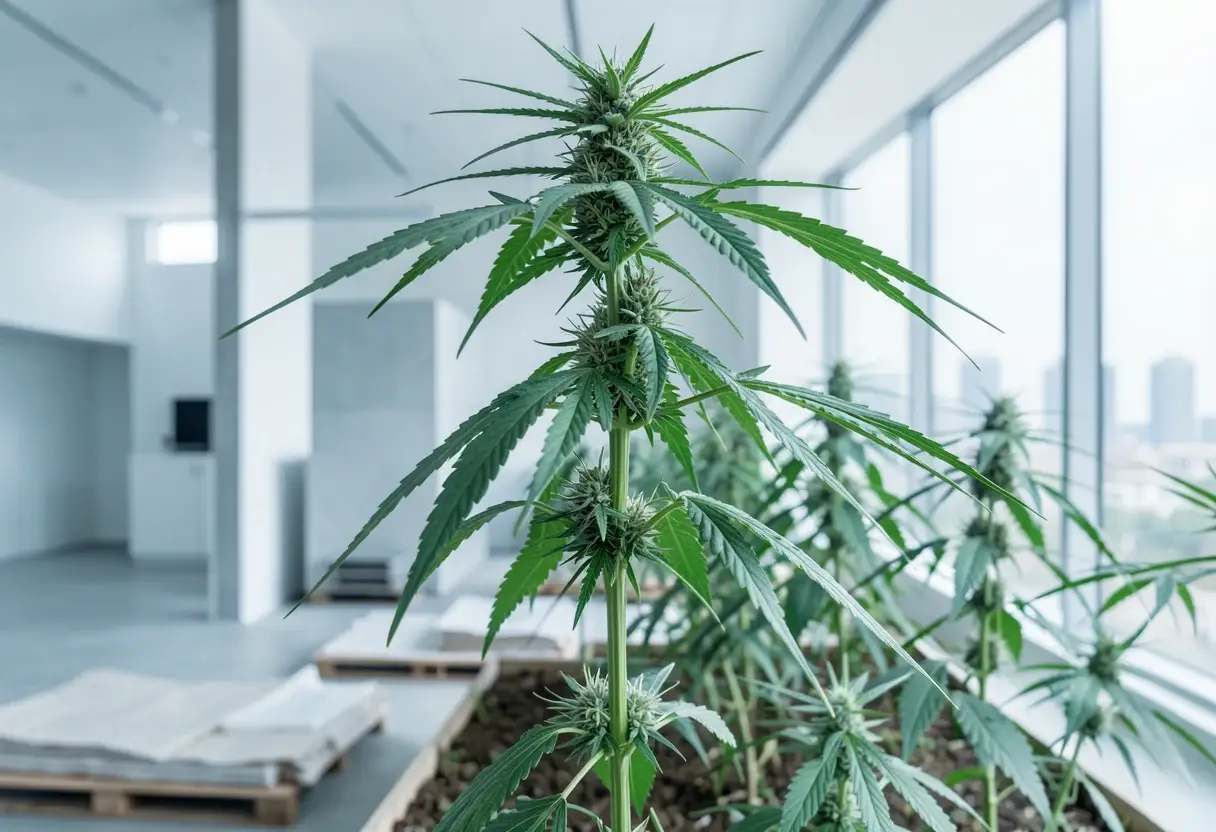
Researchers at Amity University in India have produced a hemp-based composite that reached 24.6 megapascals in compressive strength at 28 days — roughly 70 times the 0.35 MPa measured for traditional hempcrete in the same tests — while cutting estimated production emissions by 92.1% against conventional concrete. The study appeared as a preprint on Research Square and has not yet passed peer review, a caveat that matters for any portfolio decision built on its numbers.
The material combines industrial hemp particles, fly ash as an alternative binder, and cellulose nanocrystals at varying concentrations. The hemp particles were chemically treated to improve bonding with the surrounding matrix. The research team tested five mixtures in total: conventional Portland cement concrete, traditional hempcrete, and three hemp-based composites.
Why the strength jump matters
Conventional hempcrete pairs the woody inner portion of the hemp stalk with a lime-based binder. It insulates well and stores carbon, but its low compressive strength has confined it to non-load-bearing applications that require separate structural support. The new composite's 24.6 MPa figure moves hemp-based construction into the range where structural roles become plausible, though the researchers themselves flag that fire resistance, long-term durability, and other structural properties still require testing before anyone specifies the material for load-bearing use.
The strength gain did not come at the cost of weight. The best mixture had a density of 780 kilograms per cubic meter, roughly one-third that of the conventional concrete tested. Adjusted for density, its compressive strength was 2.3 times that of conventional concrete — a metric that matters for applications where dead load drives design.
What the durability and thermal data show
Two additional measured results strengthen the case, within the limits of a preprint-scale study:
- Thermal conductivity 89% lower than conventional concrete, indicating substantially better insulation performance.
- Water absorption considerably lower than traditional hempcrete.
- 89.4% of compressive strength retained after 50 freeze-thaw cycles.
The freeze-thaw figure comes from a defined test protocol, but the sample sizes and mixture variability behind it are not stated in the preprint summary. R&D managers evaluating replication projects should treat these numbers as preliminary measured results, not certified performance values.
How the carbon claim is constructed
The headline emissions figure — 32.4 kilograms of CO2 equivalent per cubic meter, against 412.5 kg for conventional concrete — depends on accounting for carbon absorbed by the hemp during cultivation. That biogenic carbon credit drives most of the 92.1% reduction. Without it, estimated emissions were approximately 47% lower than concrete. The two figures should be kept separate in any procurement or carbon-budget model: the 92% number is a best-case accounting, the 47% number is the conservative floor.
The cost gap
The material's clearest obstacle is price. The researchers estimate approximately $214 per cubic meter, versus $83 for conventional concrete — a 2.6-fold premium. They argue the composite's insulation performance could reduce or eliminate the need for additional insulation layers, partially offsetting the difference at the building-system level rather than the material level. That offset claim is a projection, not a measured result from a full building cost model.
What comes next
The study's practical significance is that hemp may now extend beyond its current primary role as insulation material toward structural applications, pending the durability and fire-resistance testing the authors say is needed. For materials R&D groups, the composite design space — chemically treated hemp, fly ash binder, cellulose nanocrystal reinforcement — is now demonstrated at preprint scale, and independent replication under peer review is the logical next milestone.
via themarijuanaherald.com (Source)
Filed under
- hemp-composites
- low-carbon-concrete
- construction-materials
- compressive-strength
- fly-ash
More from Sophie Lindqvist
Show full bio
Correspondent covering money, funding and market shifts around research and development at Hypothesis Wire.
222 articles
References
- Brimstone Targets 60% Cement CO2 Cut From a Single Silicate Rock
- QuantumScape Claims Minutes-Long Ceramic Firing as Solid-State Race Tightens
- Nano-precursor route cuts PCEC electrolyte production from 85 to 33 hours
- Higher Vinylene Carbonate Loadings Extend Life of LFP/Graphite Cells at 70°C
- Titanium metamaterial stays buoyant in seawater at 0.15% mass loss