Proceedings · Session S-739 · filed November 5, 2026
Physical Sciences ResearchSession paper
Two Science papers confirm altermagnets by magnon handedness
Two Science papers published Oct. 29 report magnons with crystal-symmetry-locked handedness in MnTe and MnF2, the firmest evidence yet for altermagnetism, a magnetic class proposed in 2022.
By Tom Whitfield3 min read519 words
Summary
- Two papers published Oct. 29 in Science identified MnTe and MnF2 as altermagnets via magnon handedness
- Jost et al. at SLAC used circularly polarized X-rays at the ESRF in Grenoble; Faure et al. used polarized neutrons at Oak Ridge's Spallation Neutron Source
- Altermagnetism was proposed as a magnetic class in 2022
- Chirality appears in some directions, vanishes along nodal directions and flips sign across them
- Altermagnets have no stray field; chirality control could carry spin information without moving electrons
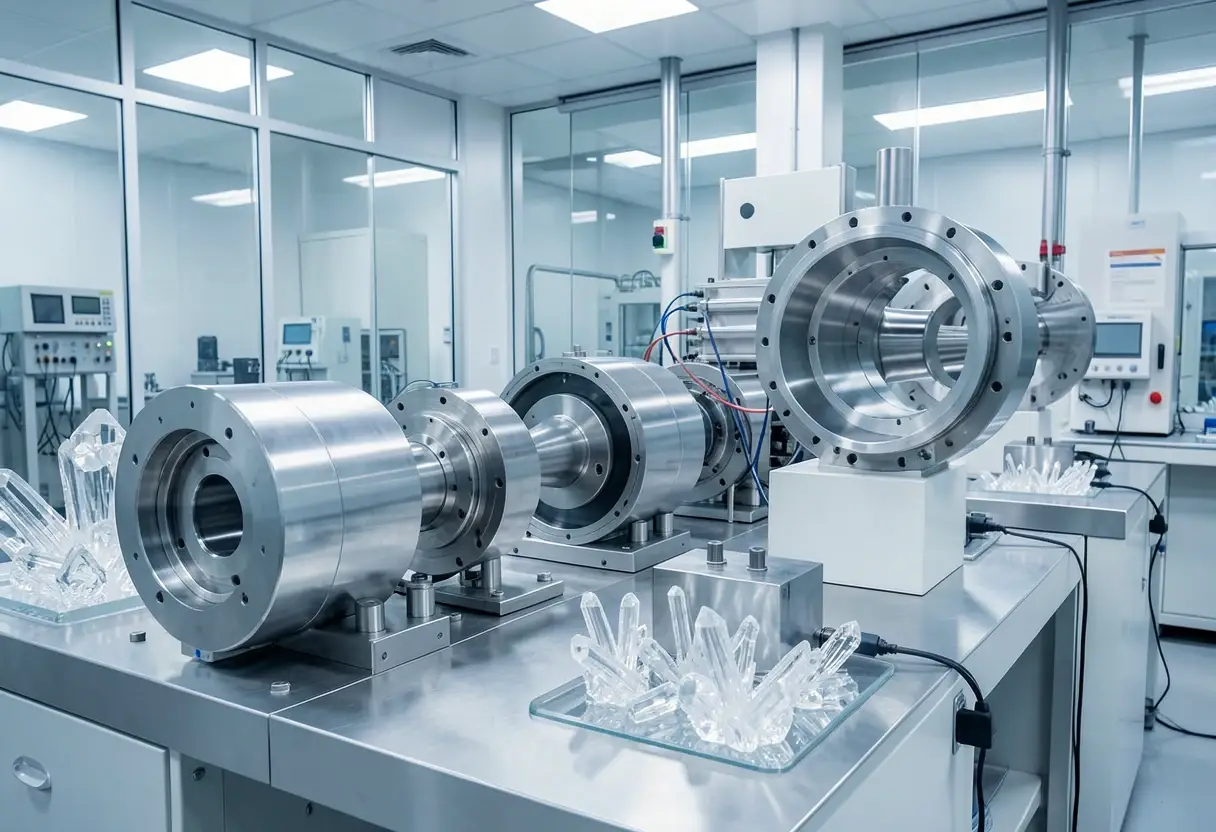
Two papers published Oct. 29 in Science report magnons with a handedness locked to crystal symmetry in manganese telluride and manganese fluoride, delivering the clearest experimental footing yet for altermagnetism, a magnetic class proposed only in 2022.
That footing matters because, until now, the case for altermagnets was circumstantial. Earlier evidence rested mostly on photoemission showing spin-split bands, nanoscale imaging, and one neutron study that found split magnon energies in MnTe. Each of those signals leaves room for alternative explanations. Chirality is harder to mistake.
What did the two teams measure?
Daniel Jost and colleagues at SLAC National Accelerator Laboratory, funded by the Department of Energy, used circularly polarized X-rays at the European Synchrotron Radiation Facility in Grenoble, France, to determine magnon handedness in MnTe. Their paper is titled "Chiral altermagnon in MnTe."
Quentin Faure and colleagues at the Laboratoire Léon Brillouin — a neutron-science lab near Paris run by France's Alternative Energies and Atomic Energy Commission and the National Centre for Scientific Research — used polarized neutrons at Oak Ridge National Laboratory's Spallation Neutron Source in Tennessee to do the same in MnF2, in "Altermagnetism revealed by polarized neutrons in MnF2."
MnF2 carries its own weight in the story. It was one of the first materials in which scientists used neutrons to observe antiferromagnetic order — neighboring spins locking into an alternating up-down pattern — and neutron-scattering courses have long used it as a textbook antiferromagnet. It now sits in a second textbook chapter.
Why is handedness the decisive test?
In an altermagnet, spins alternate up and down, so there is no net magnetization, exactly like an antiferromagnet. The twist is structural: the opposite-spin sublattices are related by a rotation rather than a translation or inversion. That splits electron and magnon behavior by spin, as a ferromagnet does, but differently along different crystal directions.
The magnon signature separates the two classes cleanly. In an ordinary antiferromagnet, the two magnon modes carry opposite handedness at the same energy, so a probe registers no net chirality. In an altermagnet, handedness shows up in some directions, vanishes along symmetry-enforced "nodal" directions, and flips sign across them.
Both papers found exactly this pattern — in MnTe and in MnF2. Two materials, two instruments, two continents, one signature.
What could lab devices gain?
Altermagnets produce no stray field. A Perspective commentary accompanying the papers notes that controlling chirality could carry spin information without moving electrons — a property with obvious appeal for anyone building spintronic devices who wants to dodge the dissipation costs of charge currents.
That is a projection, not a measured result. What is measured, as of Oct. 29, is the chirality pattern itself, in two compounds, at two major user facilities.
For R&D managers watching the spintronics portfolio, the practical reading is this: a class of materials defined in 2022 now has a harder, symmetry-based experimental test that groups can run at synchrotron and neutron sources they can already book time at. Expect follow-on work to probe whether chirality control in MnTe, MnF2 and related compounds can be driven electrically at device-relevant scales.
via science.org (Original)
Filed under
- altermagnetism
- magnons
- mnte
- mnf2
- neutron-scattering
More from Tom Whitfield
Show full bio
Senior reporter covering technology and product news in research and development at Hypothesis Wire.
237 articles