Proceedings · Session S-387 · filed November 5, 2026
Physical Sciences ResearchSession paper
107 Seconds on a Spanish Mountain: Inside Eclipse Astronomer's Iron-Ion Hunt
Czech-Hawaiian team used eight filtered cameras and 107 seconds of totality in Spain to map iron-ion temperatures across the solar corona, at roughly half the price of nothing.
By Amara Osei4 min read792 words
Summary
- Team recorded the 12 August 2026 eclipse from Pico Trigaza, Spain, with 107 seconds of totality
- Eight astrocameras with 1-nanometer spectral filters map iron ions to infer coronal temperatures of 1.4–1.6 million °C
- A single processed image requires about 3,000 input frames and more than two days of computing
- Three of five teams worldwide lost their data to clouds in Iceland; half of Sherpas expeditions typically return usable data
- First visible-light results due in about two weeks; iron-ion analysis may take until the 2027 North Africa eclipse
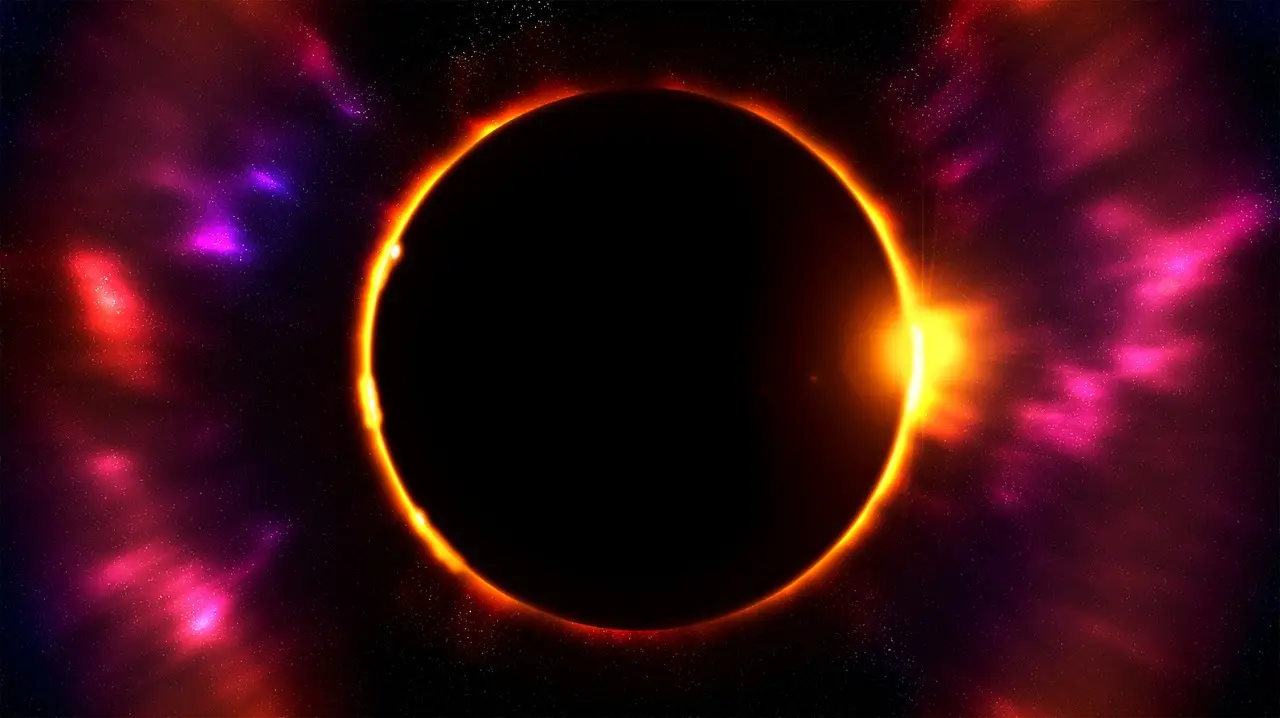
A team of Czech and Hawaiian researchers had exactly 107 seconds on 12 August to photograph the solar corona from Pico Trigaza in northern Spain, using an eight-camera instrument custom-built to map temperatures across the sun's outer atmosphere. The expedition, led by mathematician Miloslav Druckmüller of Brno University of Technology, was his 19th total solar eclipse.
The rig's purpose is specific: eight astrocameras, each fitted with a spectral filter of one-nanometer bandwidth, record light emitted by different iron ions in the corona. The logic is thermometric. Iron that has lost 11 electrons forms at roughly 1.4 million °C; stripping a twelfth electron requires about 1.6 million °C. Because each ionization state emits at a distinct wavelength and retains it as the ion rides the solar wind outward, mapping the ions maps both temperature and heat dispersal into interplanetary space.
That capability exists nowhere else, according to its co-developer. "That's something nobody else in the world can do," Druckmüller said. The technique, developed with Shadia Habbal's team at the University of Hawaii under the Solar Wind Sherpas banner, has already produced a temperature map of the entire corona, revealed plasma structures the researchers call "smoke rings," and identified the boundary where solar plasma thins enough that ions stop colliding.
Why an eclipse beats a coronagraph
The corona is roughly a million times dimmer than the solar surface yet burns at around a million degrees Celsius, against 5,500 °C at the surface. Coronagraphs block the sun's glare with an occulter, but diffraction forces the occulter to be oversized, hiding the inner corona where the most important processes occur. The moon, by coincidence of size and distance, occludes the sun without diffraction and exposes the corona nearly to the surface.
Space-based instruments have their own limits. NASA's Solar Dynamics Observatory images the innermost corona in extreme ultraviolet, Habbal explained, "but it cuts off very quickly, so you don't see its extension into space as well as we can see it in the visible emission lines." The European Proba-3 mission, launched in 2024, simulates eclipses with two spacecraft flying 150 meters apart, yet its instruments remain constrained relative to the Sherpas' ground equipment.
The processing bottleneck
Druckmüller's contribution is as much computational as optical. Corona brightness spans a contrast range of up to one million to one, while a typical computer monitor displays about 800 to one. His algorithms fuse 200 frames per final image, with exposures from 0.001 second to two seconds, calibrated against flat fields and dark frames to remove optical and sensor artifacts. Counting calibration data, one finished image consumes about 3,000 input frames. "It takes the computer more than two days to process one image," he said.
The workflow began as a two-year hobby. After his first eclipse, in Hungary in 1999, shot with a 30-year-old Soviet MTO 1,000-millimeter lens, Druckmüller spent two years of evenings on numerical processing before his images revealed magnetic field lines stretching far into space. Solar physicists took notice, though attribution initially went astray: Habbal's team published his images credited to another researcher. "I wrote her a rather disappointed email and she responded within 10 minutes," Druckmüller recalled. The correction seeded a collaboration now approaching three decades.
Site selection as risk management
Since 2008, Sherpas teams have covered every total eclipse from multiple sites to hedge weather; roughly half return with usable data. For this eclipse, three teams deployed to Iceland and two to Spain. All three Icelandic teams lost their view to a low-pressure system, validating the redundancy. Iceland offered a sun 25 degrees above the horizon versus Spain's 8 degrees, where atmospheric thickness increases distortion. The Spanish camp at 1,600 meters offset this slightly with thinner air, and the center line of totality passed within 11 kilometers.
The budget for the iron-ion instrument deserves note. A colleague laser-cut the aluminum lens plates for "two bottles of whisky"; brackets were 3D-printed at Brno; the Contax lenses came at steep eBay discounts. Only the interference filters commanded serious cost. Twenty cameras in total ran on the mountain, most drawing power from a car battery buffering grid instabilities.
The clouds dissolved ten minutes before totality. Five doctoral students, who had driven more than 2,000 kilometers from Brno and spent nearly a week preparing, executed the sequence through Baily's Beads and totality itself, which began 50 minutes before sunset.
First visible-light images are expected in about two weeks. The iron-ion analysis will take months, possibly until the 2027 eclipse over North Africa, a turnaround that measures the true cost of 107 seconds of data.
via science.nasa.gov (Original)
Filed under
- solar-physics
- solar-eclipse
- solar-corona
- iron-ion-spectroscopy
- temperature-mapping
More from Amara Osei
Show full bio
News editor covering money, funding and market shifts around research and development at Hypothesis Wire.
223 articles
References
- NASA's $4.3bn Roman Telescope Reaches for the Dark Universe
- Four 23 m Cherenkov telescopes completed in La Palma
- Off-the-Shelf Thermal Cameras Tackle LIGO's Mirror Noise Problem
- Deuterium fusion in foils plateau at rates 10^18 above theory
- AI trained on 30 years of Pingtan weather data selects hybrid storage mix