Proceedings · Session S-925 · filed November 18, 2026
Physical Sciences ResearchSession paper
Stanford thermal-noise link raises data rate 100-fold
Stanford researchers transmitted bits through conductor thermal noise without an active radio signal, then used channel modeling to raise laboratory throughput 100-fold.
By Sophie Lindqvist3 min read698 words
Summary
- Stanford’s PNAS team raised laboratory data-transfer rate 100-fold by tuning the setup with a channel model.
- The transmitter encoded 1 and 0 by switching its antenna between open and short circuits inside an anechoic chamber.
- Geneva Ecola said an RF transmitter can use up to 1,000 times more energy than the thermal-noise system.
- Testing remains confined to a controlled chamber with minimal external interference; the next phase will involve multiple transmitters.
By Sophie Lindqvist
Stanford University researchers increased the data-transfer rate of a thermal-noise link by a factor of 100 after developing a channel model, according to their paper in PNAS. The work manipulated thermal noise produced by tiny voltage oscillations in an electrical conductor to transmit data without actively producing a radio signal, then used the model to tune the laboratory setup.
The report gives no absolute throughput, so the gain cannot yet be compared with Wi-Fi, broadcast or other conventional links. It also gives no link range, error rate or number of trials and identifies neither a funder nor an industrial partner.
How did thermal noise carry information?
Thermal noise usually troubles engineers because it lowers a system’s signal-to-noise ratio and sensitivity. It arises from random movement of charge carriers in conductors at temperatures above 0 K and is also called Johnson noise; measuring it gives a conductor’s temperature.
Astronomers treat related noise as signal: radio observations involve blackbody radiation and the cosmic microwave background left by the Big Bang. Stanford electrical engineer Zerina Kapetanovic and colleagues adapted a switching method used in radio astronomy, which moves between the noise source under study and a known reference source, to encode a communication link.
What changed after channel modeling?
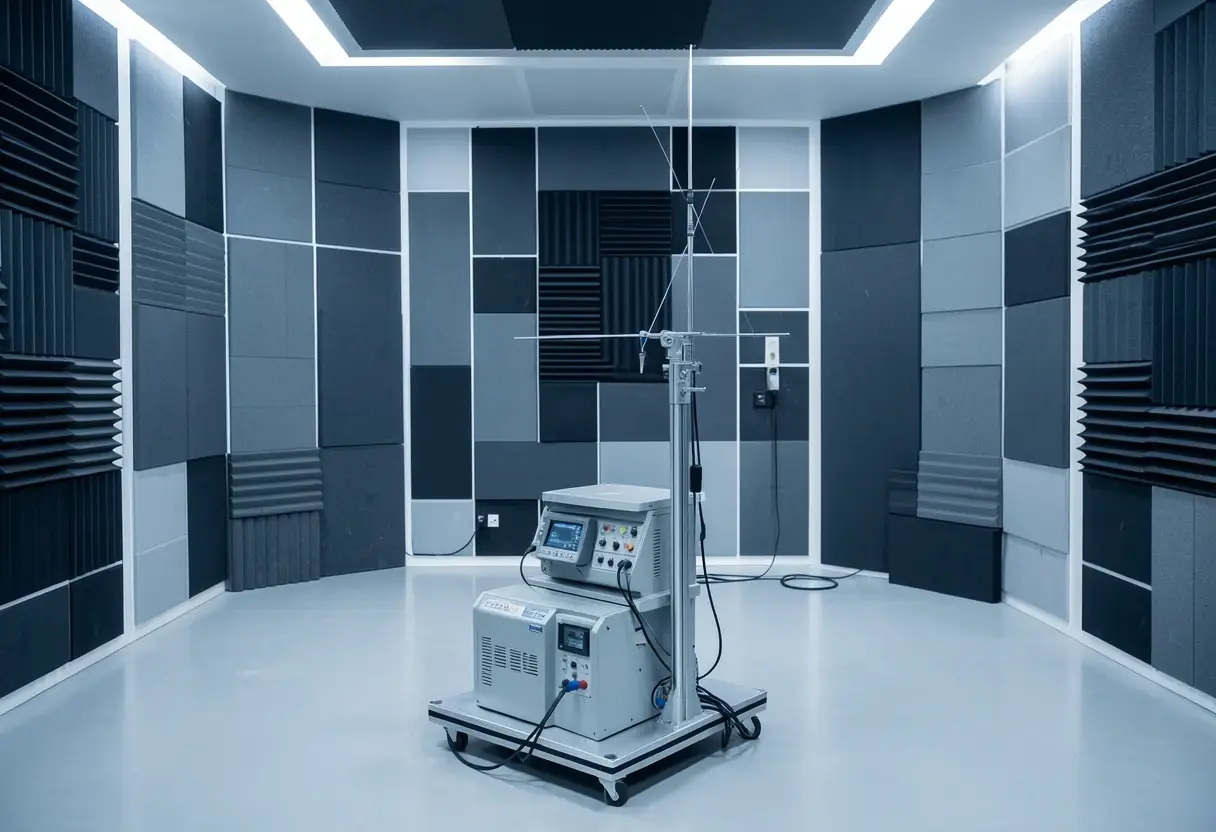
To test the idea, the team placed the transmitter and receiver inside an anechoic chamber insulated against other noise sources because thermal noise is extremely weak. At the transmitter, an antenna switched between an open circuit, denoted 1, and a short circuit, denoted 0, producing the two fundamental computing bits without an active radio signal.
At the receiver, the team amplified thermal noise reflecting from the antenna and decoded the transmitted information. The researchers then built a comprehensive model of the transmitter-receiver channel and used it to adjust the apparatus, improving data transfer by 100 times.
Kapetanovic said such models form the foundation for optimizing performance and making a wireless system practical for real deployment. The 100-fold increase is a measured laboratory outcome; movement from a controlled chamber to a deployable network remains a stated objective rather than a demonstrated result.
What do the energy and interference claims establish?
The team says the link does not occupy radio-frequency (RF) bandwidth already allocated to Wi-Fi or broadcast television, and it needs very little energy to operate. Geneva Ecola said: “A transmitter relying on radio frequencies uses up to 1000 times as much energy to send information compared to a transmitter using only thermal noise.”
That comparison is the team’s claim. The report supplies no direct power measurements for the two transmitter types, operating range or deployment conditions.
Ecola also said active signals can create unwanted interference in settings where small RF emissions matter. The report names radio-astronomy observatories and hospital facilities with radiation-sensitive equipment, where even the smallest active RF signals can disturb the signals those systems detect. The researchers argue that a thermal-noise link would avoid that interference; they have not tested the assertion in either operational environment.
What remains unmeasured?
Jida Zhang told Physics World: “So far, our evaluation has been limited to a controlled environment with minimal external interference.” The report gives no antenna dimensions, chamber size, absolute bit rate, bit-error rate, operating power, trial count, funding source or independent replication.
For R&D managers, those omissions prevent a defensible comparison of data throughput, spectrum impact and energy use against an active transmitter. A procurement or spectrum-planning decision based on the present data would rest more on projections than measured performance.
What must happen before deployment?
The team’s next step is a network with multiple transmitters, alongside tests in environments noisier than the anechoic chamber. Zhang said the researchers also want to identify practical applications and measure performance under real-world conditions.
For portfolio planning, the immediate milestone is a measured package covering absolute rate, range, error performance, power, antenna configuration and operation without chamber isolation. If those tests reproduce the 100-fold tuning gain while testing the energy and interference claims, the team will have a stronger basis for deciding whether a multi-transmitter network merits further investment.
via zerinakapetanovic.com (Original)
Filed under
- thermal-noise
- wireless-communication
- channel-modeling
- johnson-noise
- radio-astronomy
More from Sophie Lindqvist
Show full bio
Correspondent covering money, funding and market shifts around research and development at Hypothesis Wire.
242 articles
References
- Machine Design Claims Heat Transfer Advances Reshape Lab Equipment
- Nature calls for tech-transfer culture shift in astrophysics
- Two teams demonstrate first working nuclear clocks in Nature
- NASA Bets on Compact Lab Hardware to Reshape Research Workflow
- Solar Storm GLE 77 Breached Aviation Radiation Thresholds Unannounced