Proceedings · Session S-209 · filed September 30, 2026
Physical Sciences ResearchSession paper
Magnetite nanoparticles made in dye-polluted water cost $3,730/kg and keep working
Cairo–Illinois team formed magnetite directly in dye-polluted water, captured >90% of two dyes, then reused the loaded particles — at $3,730/kg, eight times cheaper than cobalt ferrite.
By Priya Raman4 min read736 words
Summary
- Magnetite nanoparticles synthesized directly in dye-polluted water adsorbed >90% of congo red and bromocresol green, at a production cost of ~$3,730/kg versus ~$30,100/kg for cobalt ferrite.
- The same dye-loaded particles adsorbed ~80% of methylene blue after ~3 h in a single-dye system, dropping to just over 50% with methyl orange present; alcohol rinsing enabled four reuse cycles with no performance loss.
- In tap water, removal fell to roughly half the distilled-water level, and the required adsorbent dose rose ~15×, from 0.67 to 10 g/l.
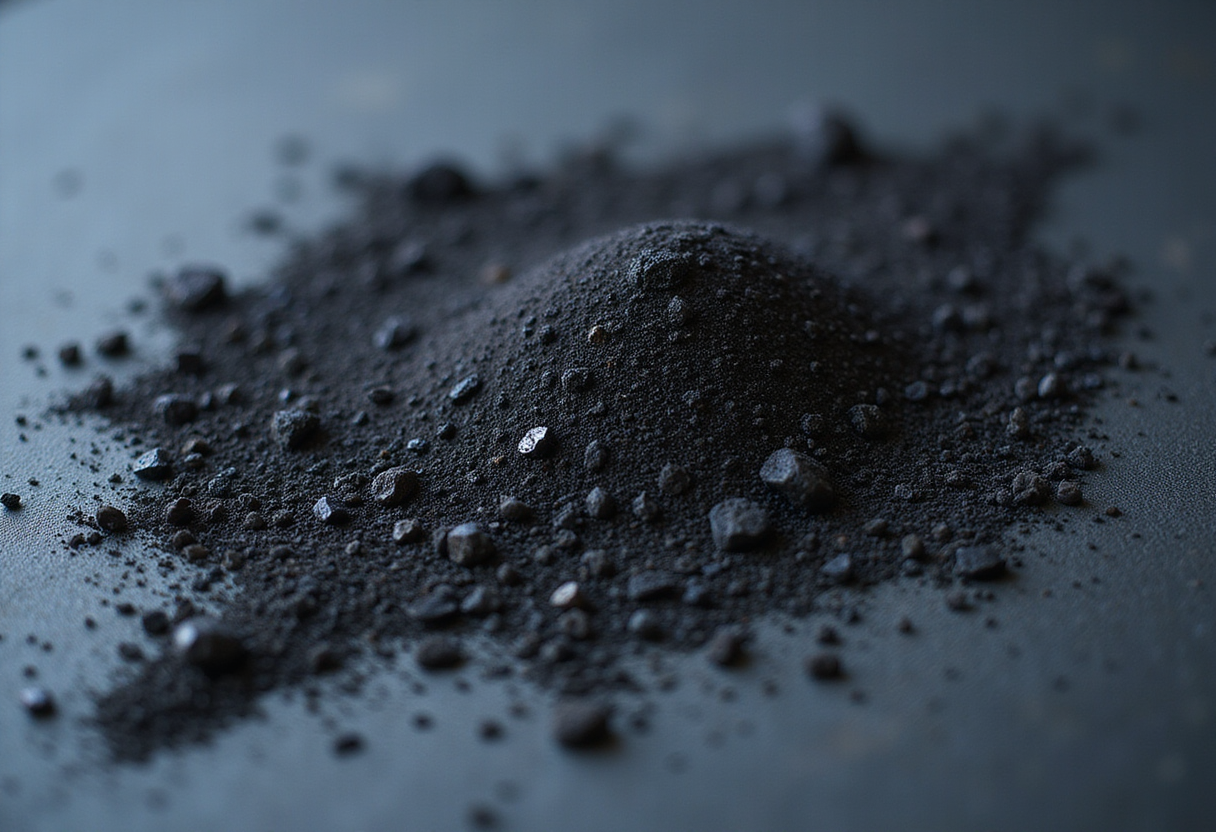
Researchers at The American University in Cairo and the University of Illinois Chicago have synthesized magnetite nanoparticles directly inside dye-contaminated water, captured more than 90% of two dyes as the particles formed, and then reused the same dye-loaded particles to adsorb additional contaminants — all for a production cost of roughly $3,730 per kilogram, about eight times cheaper than cobalt ferrite at approximately $30,100 per kilogram.
The method, published in RSC Advances, eliminates the conventional make-wash-dry-treat sequence that normally precedes deployment of nanoparticle adsorbents. Instead, lead researcher Hebatullah Hassan Farghal and her colleagues form the magnetite — a naturally magnetic iron oxide — in situ. The particles pull dye molecules onto their surfaces as they grow, leaving the water cleaner and producing a pre-loaded adsorbent in a single step.
The scale of the problem is substantial. Industry discharges roughly 5,000 tonnes of dyes into wastewater each year, blocking light from aquatic organisms, generating odours and posing human health risks. Congo red persists in the environment, and methyl orange resists standard biological and chemical treatments and has been linked to cancer and DNA damage.
Measured performance
The numbers come from controlled laboratory conditions, and the team reports them with that caveat intact. When the nanoparticles formed in dye-polluted water, more than 90% of both congo red (CR) and bromocresol green (BCG) adsorbed onto the particles. The loaded particles grew to about 34 nm, versus 26 nm for plain magnetite.
The researchers then put those dirty particles to work again. They adsorbed almost 80% of methylene blue (MB) from a single-dye system after roughly 3 h. When they added methyl orange to the mix, MB removal fell to just over 50%. Rinsing the particles in alcohol stripped the trapped MB without damaging the material; the team repeated this four times with no performance drop and no leakage of the originally loaded dyes. MB removal performed best at high pH, where the negatively charged nanoparticles attracted positively charged MB molecules — an electrostatic boost to the main binding mechanism.
Infrared spectroscopy of the particle surface indicated that physisorption — weak, static-cling-style attraction without permanent chemical bonds — dominates the binding of CR, BCG and MB. That weak binding explains why ethanol washes could recover the dye repeatedly.
Ahmed A Abokifa and Mohamed S Mohamed at the University of Illinois Chicago ran density functional theory simulations to check this interpretation, modelling a single dye molecule on a magnetite surface. All dyes bound with similar strength. The simulations showed electrons flowing from negatively charged CR and BCG toward the surface, and from the surface toward positively charged MB — matching the charge-driven attraction observed experimentally. The team explicitly cautions that DFT and lab results cannot be compared quantitatively, only qualitatively: the simulation examines a perfect molecule on an ideal surface, while experiments operate under real-world conditions. Mayyada El-Sayed supervised the wider study.
The tap-water gap
Real water complicates the picture. In standard tap water and 3% NaCl saline, the researchers had to raise the adsorbent dose roughly 15-fold, from 0.67 to 10 g/l. The increase compensated in saline. In tap water, removal dropped to about half the level achieved in distilled water — likely because calcium, magnesium and other naturally present substances compete with dyes for sites on the particle surface.
"Though the dose significantly increased in tap water and saline, this dose is still applied in the literature," Farghal says. Her follow-up work will target that gap and cut costs further.
The idea's origin was informal. "The idea for this paper came exactly one or two days after my PhD defence," Farghal explains. "While I was having breakfast, I realized adsorbent synthesis requires time and cost…I then went to the lab and started my experiments to find that it was successful."
For R&D managers evaluating wastewater treatment portfolios, the economics and the reusability are the operative figures: a $3,730/kg adsorbent that works through four regeneration cycles with no measurable performance loss, but that currently needs a 15× dose escalation in tap water to approach bench-scale results.
Farghal says her next research will involve "circular economy approaches that will be outside the box" — treating waste from one process as feedstock for the next, a logic this study already demonstrates by turning dye-polluted water into the reaction medium for a working adsorbent.
via scholar.google.com (Original)
Filed under
- nanomaterials
- wastewater-treatment
- adsorption
- magnetite-nanoparticles
- rsc-advances
More from Priya Raman
References
- Fraunhofer IFAM Opens Electrolysis Prototype Centre
- In-situ XAS decodes activity-durability trade-off in MXene-supported Pt alloys
- Cotton and Lee press DOE to bar Chinese nationals from national labs
- Trump's FY2027 Budget Seeks 54.5% Cut to NSF, Sweeping Science Reductions
- Loop Chemicals Licenses Sandia Chemical Looping Ammonia Tech