Proceedings · Session S-451 · filed October 10, 2026
Physical Sciences ResearchSession paper
Fin spacing governs heat transfer in 3D PCM models, Rome team reports
Tor Vergata researchers modeled fin arrays inside phase change materials in 3D using lattice Boltzmann methods. Closely spaced fins interfere and waste energy; spaced fins trigger convection that accelerates melting.
By Rebecca Stone3 min read568 words
Summary
- Published in EPL, DOI 10.1209/0295-5075/ae7ab8, by Proia, Sbragaglia and Falcucci at the University Tor Vergata of Rome
- Multiple fins of equal total surface area outperform a single large fin when spaced apart, because gap melting seeds larger convective structures
- Closely spaced fins produce overlapping influence zones that waste energy re-melting already-liquefied PCM
- 3D lattice Boltzmann simulations scale as N³ grid sites versus N² in 2D, making single-iteration speed the main computational bottleneck
- Primary application target is metal-hydride hydrogen storage, where PCM heat capture during adsorption can improve desorption efficiency
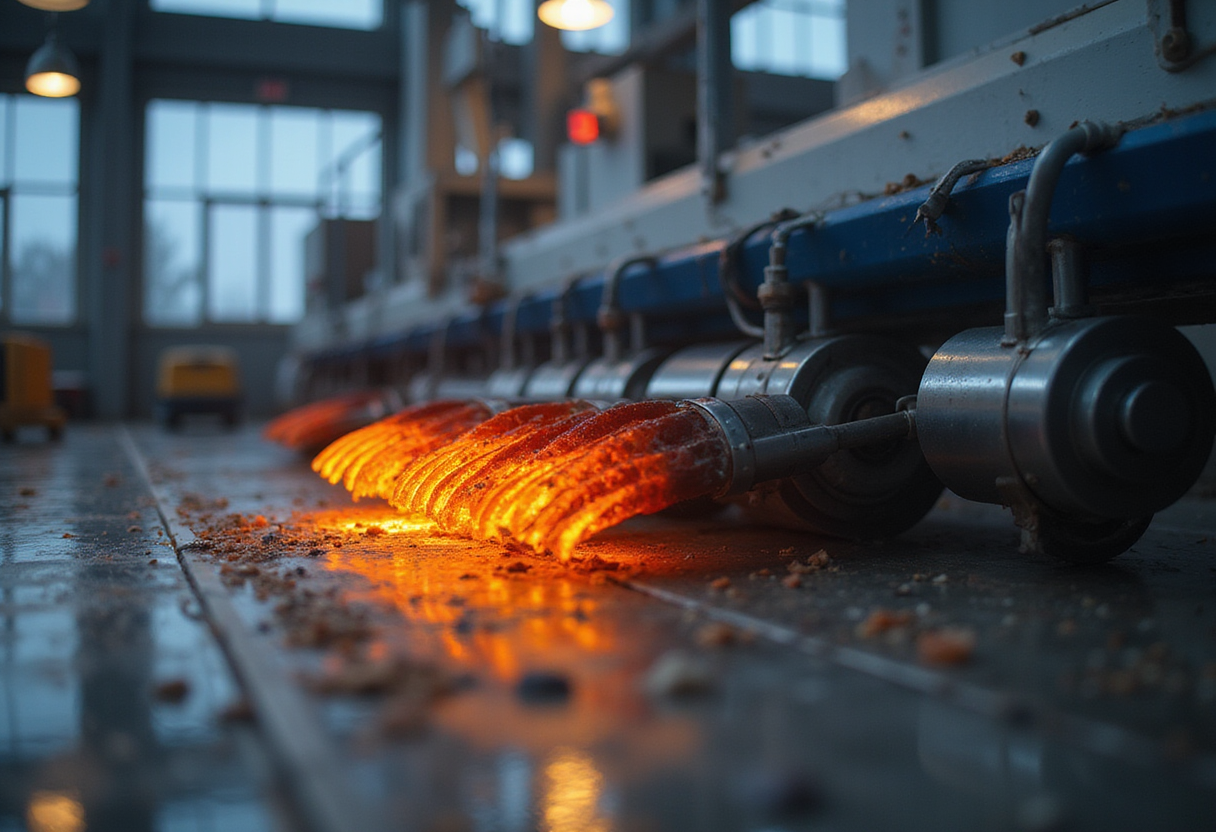
Adding more fins to a phase change material (PCM) can slow melting rather than accelerate it, according to lattice Boltzmann simulations published in EPL (DOI: 10.1209/0295-5075/ae7ab8) by Paolo Proia, Mauro Sbragaglia and Giacomo Falcucci at the University Tor Vergata of Rome.
The team extended their prior 2D work (arXiv: 2507.04851) to three dimensions to ask a deceptively simple engineering question: how should PCM designers space fins inside a thermal store? Their central finding reframes fin layout as a separation problem, not a density problem.
Why does fin spacing matter?
PCMs excel at storing latent heat but transfer sensible heat poorly. Fins help by enlarging the heat-transfer surface and seeding convection. The Rome group compared one large fin with several smaller fins of equal total surface area.
"We found that the latter configuration benefits from the gaps between the fins," the researchers told Physics World. "This is because the substance in these gaps melts early and starts acting as an extra heating surface, contributing to the development of bigger convective structures."
For thermal-store designers, the take-away is direct: packing fins into a PCM volume buys little, while distributing them with deliberate gaps accelerates the onset of convection — the dominant heat-transfer mechanism in this regime.
What changed in moving from 2D to 3D?
The shift expanded the design space but raised the compute cost sharply. In 2D, the lattice Boltzmann grid scales as N² sites; in 3D, it scales as N³. The team validated parameter ranges where the lattice Boltzmann approximation holds, then balanced resolution against single-iteration speed. That speed is the main bottleneck.
A slower-melting PCM demands more iterations to complete its phase transition, multiplying real-world simulation time. The team had to choose N carefully to capture all relevant dynamics without making each iteration prohibitively slow.
The deeper analytical challenge goes beyond raw compute. Convection couples with temperature dynamics inside PCMs, and the latent-to-sensible phase change adds a moving boundary that the governing equations must track. The researchers treated that as a validation problem as much as a numerical one.
What applications does this target?
The paper frames PCMs as thermal batteries relevant to the energy transition. The team cites metal-hydride hydrogen storage, where adsorption releases heat that a PCM could capture and return during desorption, lifting round-trip efficiency. They also name solar panel thermal management and daytime building cooling as adjacent use cases.
Each shares the same engineering requirement: rapid, repeatable melting and solidification cycles within a confined volume. For R&D managers evaluating PCM procurement, the implication is that fin geometry — not just total surface area — drives performance. Specifications that count fins per unit volume will misallocate material.
What comes next?
Faster single iterations. The current code limits how many layouts and physical regimes the team can sweep. They also flagged parameter ranges that destabilise the simulation and plan to adopt known stabilising schemes.
"We'd like to study a wider range of layouts and physical conditions," the team said, "but with the code we have now, that would impact heavily on performance."
The group invites analytical and experimental replication and intends to run their own bench tests as a computational benchmark in the medium term. The new 3D results sharpen the engineering rule for fin layout: favour separation over density when designing the next generation of phase change thermal stores.
via linkedin.com (Original)
Filed under
- phase-change-materials
- heat-transfer
- lattice-boltzmann-method
- thermal-energy-storage
- computational-fluid-dynamics
More from Rebecca Stone
Show full bio
Market editor covering marketplaces and e-commerce at Hypothesis Wire.
183 articles
References
- Machine Design Claims Heat Transfer Advances Reshape Lab Equipment
- Cling-film stamp moves 1 mm 2D layers with near-unity yield
- Kyushu team reports self-docking flexible circuits with sub-100 μm actuators
- Thermo Fisher Adds 250-Liter Stackable Chambers to Heratherm Line
- Titanium metamaterial stays buoyant in seawater at 0.15% mass loss