Proceedings · Session S-151 · filed November 10, 2026
AI & Emerging Tech in R&DSession paper
DARPA-Funded Caltech Robot Assembles Truss in Orbit, a First for Space Construction
A Caltech robot funded by DARPA assembled a truss segment in orbit for the first time, but ground crews made the decisions in 15-minute contact windows.
By Amara Osei4 min read710 words
Summary
- A DARPA-funded Caltech robot assembled a truss section in orbit, described as the first autonomous space construction of a structure from parts.
- The ASTRA project targets a 1.4-meter (4.6-foot) reflector antenna built from composite tubes, aluminum joints and reflective film.
- Ground contact was limited to a few daily windows of about 15 minutes each, with engineers solving problems on a duplicate lab model.
- NASA's comparable Archinaut One (OSAM-2) project, combining 3D printing and robotics, ended in 2023 after surface demonstrations.
- DARPA's NOM4D program projects kilometer-scale orbital structures; no scale approaching that exists today.
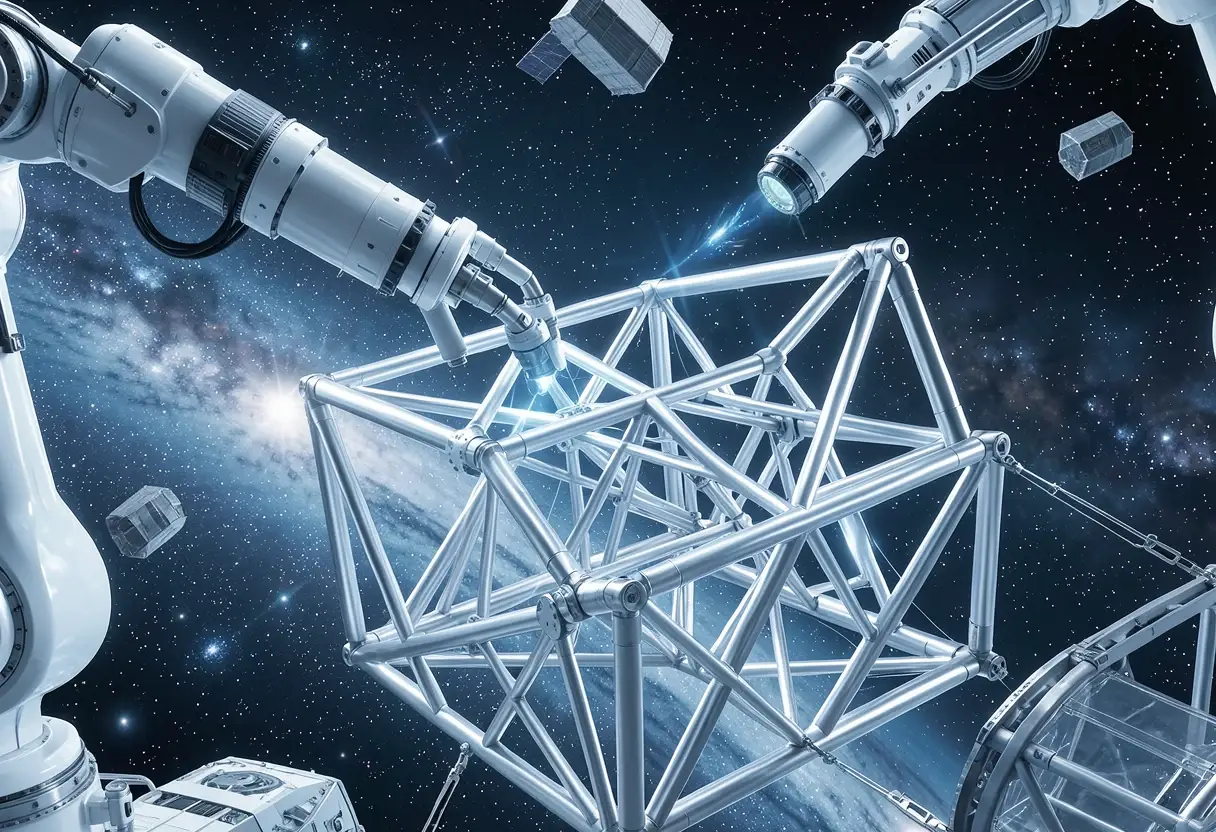
A robot funded by DARPA and designed at Caltech has assembled a structural truss segment in orbit from individual composite tubes and aluminum joints — a first for autonomous construction in space. The milestone, part of the Autonomous In-Space Tensioned Reflector Assembly (ASTRA) project, produced a single support element for a planned 1.4-meter-wide (4.6-foot) reflector antenna. No complete dish yet; one joint of the scaffolding, assembled at an altitude where no engineer can check the fit.
The demonstration matters because launch economics punish size. Pushing a large finished structure into orbit demands a heavy rocket and a structure engineered to survive launch loads. Shipping raw materials or small components instead, then building in situ, inverts that constraint. Andrew Detor, program manager for DARPA's Novel Orbital and Moon Manufacturing, Materials and Mass-efficient Design (NOM4D) program, frames the payoff in kilometer-scale terms.
"Nothing approaching that scale can be achieved today," Detor said of structures kilometers wide. NOM4D's broader vision covers antennas, optics and solar arrays engineered for their working environment rather than for surviving a ride up.
What exactly did the robot build?
Time constraints limited the task. Two truss sections launched pre-assembled; the robot then joined a third in orbit, working with composite tubes, aluminum joints and reflective film supplied as separate parts. DARPA likens the construction logic to Tinkertoys or K'Nex: repeat a simple sequence, and the finished structure can far exceed the size of the machine building it.
Detor credits deliberate simplicity over sophistication. "Within the automated assembly box, each section is built piece by piece, a reflective mesh is attached, and the assembled sections are deployed as they are complete. There are no complicated robotics or advanced algorithms; it's just solid engineering from the Caltech team to combine operations in a way that scales," he said.
That claim deserves scrutiny. The word "autonomous" carried less weight than the announcement implies. Contact with the spacecraft was restricted to a few windows per day, each roughly 15 minutes. During those windows, engineers reviewed photographs, diagnosed problems against a duplicate model in their laboratory on the ground, and then issued commands to the robot. The hardware turned the wrench, so to speak; the judgment stayed in Pasadena. True autonomy — a robot diagnosing and correcting its own errors without a ground crew and a physical twin — remains unproven.
How does this compare with prior orbital robotics?
Space construction has a long robotic history, and the ASTRA result narrows a specific gap in it.
- Canadarm2 helped assemble the International Space Station by maneuvering large pre-built components while astronauts performed installations. It joined hardware manufactured on Earth; it did not build structure from parts.
- In 2014, a 3D printer aboard the ISS fabricated a faceplate for its own extruder casing, proving that orbiting manufacture of replacement parts is feasible.
- NASA's Archinaut One (OSAM-2) aimed to 3D-print structural beams in free flight and deploy a solar array, combining additive manufacturing with robotic manipulation. Surface demonstrations showed promise before the project ended in 2023.
ASTRA occupies the space between these precedents: not astronauts bolting together finished modules, and not a printer making parts from feedstock, but a machine aggregating discrete components into a larger structure in vacuum.
What remains untested?
The reflector antenna itself is unfinished. The 1.4-meter target remains a target, and the reflective mesh deployment sequence that Detor describes has not been exercised end-to-end in orbit. Scaling from three truss sections to structures kilometers across involves unaddressed problems: thermal cycling, alignment tolerance over thousands of joints, and failure recovery without daily 15-minute ground interventions. DARPA has released no schedule for the next flight demonstration, no cost figures for ASTRA beyond the program's existence, and no measured performance data on the assembled segment's stiffness or precision.
For R&D managers watching in-orbit servicing and assembly, the signal is real but early: one joint, one orbit, one ground-controlled sequence. Detor's kilometer-scale projection is a program aspiration, not a measured result. The next credible milestone would be a full reflector assembled and deployed with mesh attached, executed with reduced ground dependency — the point at which "automated" stops doing heavy lifting.
via newatlas.com (Source)
Filed under
- darpa
- caltech
- space-robotics
- in-orbit-assembly
- autonomous-construction
More from Amara Osei
Show full bio
News editor covering money, funding and market shifts around research and development at Hypothesis Wire.
232 articles
References
- Sandia's Aires Tide Reaches National Mall After 5-Month AI Build
- Sandia completes final Mobile Guardian Transporter crash test
- UAE's Asteroid Probe Is Designed to Crash Into Its Target
- MIT modules retain electrical links through 10,000 compressions
- DRDO Transfers 20-Tonne Heavy Drop System Tech to JCBL Group