Proceedings · Session S-357 · filed September 29, 2026
Research Funding & PolicySession paper
Sokoto University Targets Nigeria's Research–Policy Divide
Sokoto State University has announced an initiative to close the gap between academic research and public policy, Punch Newspapers reports, joining Nigerian universities working to convert scholarly output into government action.
By Tom Whitfield5 min read915 words
Summary
- Sokoto State University has announced an initiative to bridge the gap between its research output and public policy, as reported by Punch Newspapers.
- The available report specifies no funding figure, timeline, named programme or participating government departments.
- The initiative's credibility will depend on implementation details — a funded policy unit, ministry partnerships and measurable engagement targets.
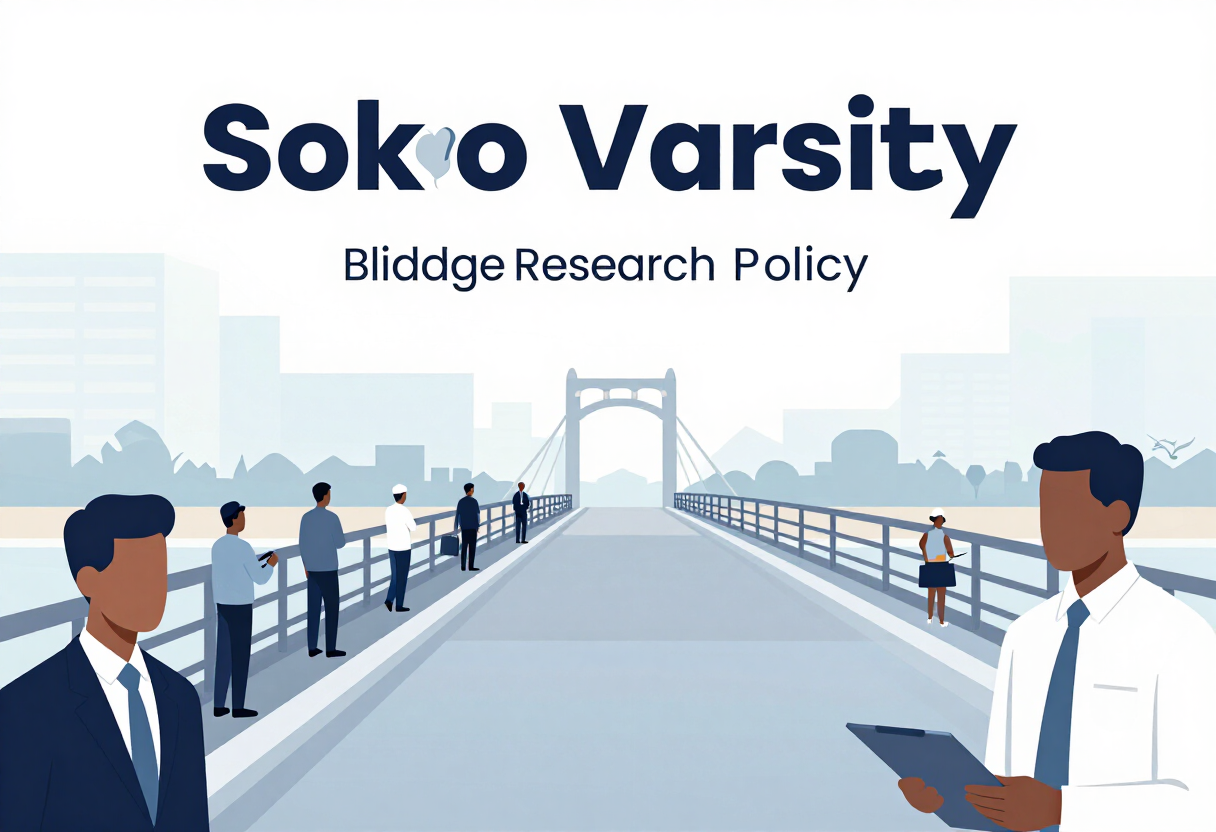
Sokoto State University has announced an initiative to close the gap between academic research and public policy, according to a report from Punch Newspapers. The move places the institution among a growing set of Nigerian universities attempting to convert scholarly output into actionable guidance for government, rather than leaving it to accumulate in journals that policymakers rarely read.
The announcement itself is the story, and its limits deserve stating plainly: the source material consists of the headline and the reporting outlet, Punch Newspapers, one of Nigeria's most widely circulated dailies. Punch's coverage signals editorial judgment that the initiative is newsworthy at a national level, but the details — funding amounts, timelines, named programmes, participating government departments — are not specified in the available report. For R&D managers and research administrators tracking African higher-education policy, the signal is directional rather than quantitative.
Why the research–policy gap matters in practice
The problem the Sokoto institution is addressing is well documented across sub-Saharan Africa and beyond. Universities produce research; ministries make decisions; the two streams rarely intersect at the point where evidence could alter an outcome. The consequences are concrete. Studies sit unpublished or unread. Government agencies commission duplicate work because they lack awareness of existing local findings. Procurement, health, agriculture and education policies proceed without reference to data generated in the same state, sometimes on the same campus.
For a university, the gap also carries budgetary weight. Institutions that cannot demonstrate policy relevance struggle to justify public funding, struggle to attract development-partner grants, and struggle to retain researchers who want their work to matter beyond citation metrics. Bridging the divide is therefore not only an academic-integrity exercise but a portfolio decision: it affects how the university positions itself for state appropriations, foundation funding and collaborative agreements with international research funders.
Sokoto State University operates in a region where these pressures are acute. Northwestern Nigeria faces persistent challenges in basic education, public health delivery, agriculture and water resources — domains where locally generated evidence could inform state-level spending priorities. A university that builds a functioning interface with the Sokoto State government creates a channel through which faculty research can reach the officials who control those budgets.
What such initiatives typically involve
Universities that have attempted this transition elsewhere in Nigeria and comparable markets tend to pursue a recognizable set of mechanisms. None can be confirmed for Sokoto from the available report, but they define the checklist against which the initiative should be assessed as details emerge.
The first is a formal knowledge-brokerage unit — a policy unit or research-to-policy office that packages faculty findings into briefs sized for civil servants rather than journal referees. The second is direct institutional linkage: memoranda of understanding with state ministries that give researchers access to government data and give officials access to academic expertise. The third is dissemination reform, shifting incentives so that policy engagement counts toward promotion and appraisal rather than disappearing from the metrics entirely. The fourth is funding: without a dedicated line — whether from the state, the university's own budget or external partners — such units typically stall within two to three years.
Each mechanism carries a measurable test. How many policy briefs produced? How many ministry requests for evidence fielded? How many researchers redirected ongoing projects toward questions a department actually asked? These are the indicators that separate a genuine operational change from a launch announcement.
Questions for research managers watching this space
For R&D administrators at peer institutions, the Sokoto announcement raises due-diligence questions that apply to any university-level research-to-policy programme. Who funds it, and for how many years? Does the initiative have a named director and staff, or does it exist as a committee mandate attached to existing portfolios? Is there a target state department — health, education, agriculture — or does the commitment remain general? And critically, what baseline data will the university use to measure movement, given that research-policy engagement is notoriously difficult to count?
The funder question matters most. Initiatives of this type in West Africa have historically depended on development-bank and foundation support — the World Bank, the Ford Foundation, various UK aid-linked research programmes — and sustainability after the grant period ends is the most common failure mode. A state-funded model has different risks: political turnover can sever the relationship precisely when it matures.
The measured-versus-projected distinction
What is measured here is minimal: one institution has publicly committed to narrowing the distance between its research enterprise and policy processes. What is projected is everything else — improved policy uptake, stronger state research funding, better development outcomes in Sokoto State. Punch's report does not yet provide the numbers that would let a reader distinguish ambition from capability, and analysts should resist treating the announcement itself as evidence of impact.
The credible benchmark will arrive in the implementation details. A named policy unit with a budget line, a first tranche of ministry-facing outputs, and a stated target for annual engagement would convert this from positioning into programme. Until then, the initiative belongs in the category of institutional intent: significant as a signal of direction, unproven as a mechanism.
The university's next moves — whether it publishes a structure, names partners in government, or attaches funding to the commitment — will determine whether Sokoto becomes a case study in research-to-policy practice or another entry in the long list of universities that announced the bridge before building it.
via Google News: Research & science policy (Source)
Filed under
- research-to-policy
- nigeria
- higher-education
- sokoto-state-university
- policy-impact
More from Tom Whitfield
Show full bio
Senior reporter covering media and advertising at Hypothesis Wire.
92 articles
References
- Nigeria's Tinubu Sends Bill to Create National Research Council
- Nigeria's Tinubu Sends Research Fund and Medical College Bills to Parliament
- Tinubu Pushes New Funding Model for Nigeria's Research Sector
- Tinubu Asks Nigerian House to Back National Research Fund
- Tinubu Sends Medical College and Research Fund Bills to Assembly