Proceedings · Session S-847 · filed September 29, 2026
Corporate & Industrial R&DSession paper
Siemens Healthineers launches Accela linac for 60-second SBRT
Siemens Healthineers unveiled Accela at ASTRO 2026: 40 Gy/min dose rates, 6.25 cm/s MLC leaves and NeoArc DMAT for sub-60-second SBRT. First patients in December at Maastro.
By Rebecca Stone3 min read621 words
Summary
- Accela delivers multi-site SBRT in under 60 seconds, including HyperSight CBCT imaging, couch shifts and treatment, using gantry rotation up to 2.5 rpm and dose rates up to 40 Gy/min.
- The NeoArc DMAT technique optimizes dosimetric objectives and delivery efficiency simultaneously, unlike conventional VMAT which optimizes dose distribution primarily.
- First patient treatments are scheduled for December at European centres including Maastro in the Netherlands, with CE mark in hand and FDA clearance expected early next year.
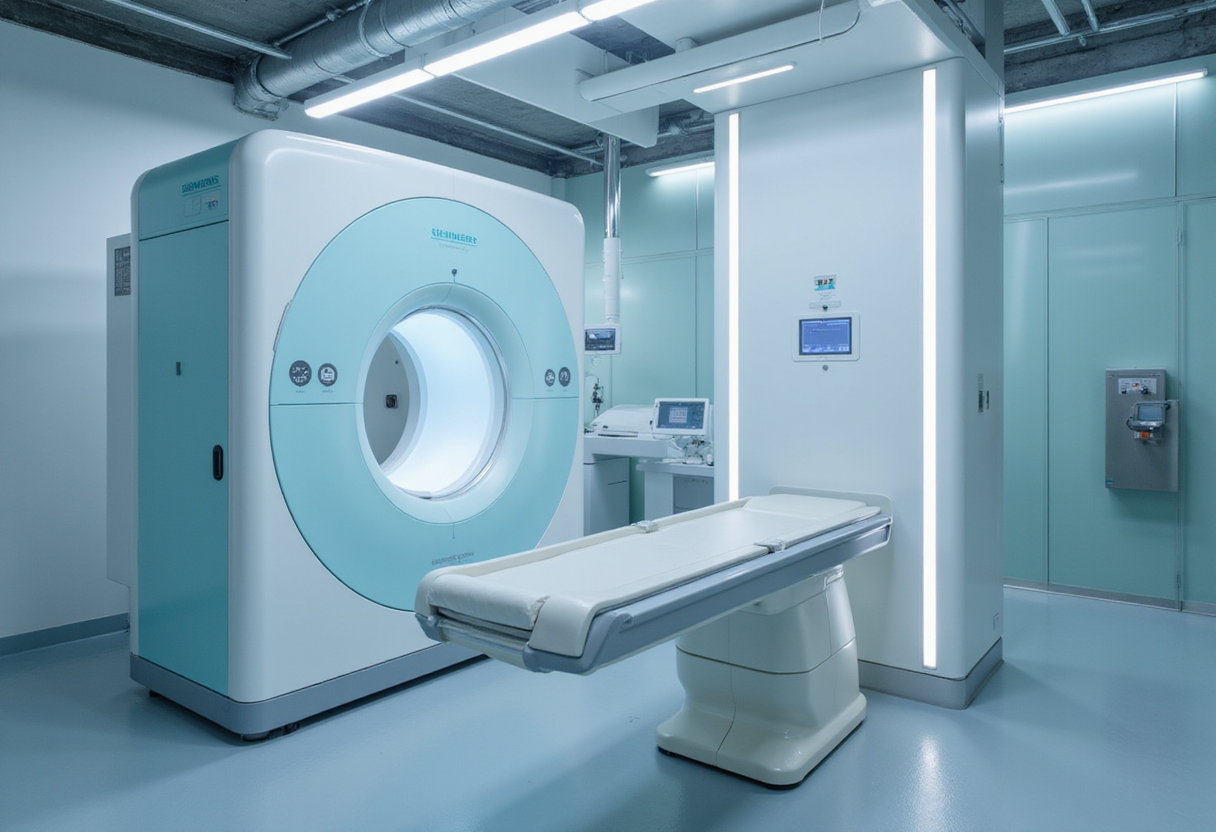
Siemens Healthineers used this week's ASTRO 2026 annual meeting in Boston to launch Accela, a radiotherapy delivery system that can complete multi-site stereotactic body radiotherapy (SBRT) in under 60 seconds — including on-couch imaging, couch shifts and dose delivery. The company says the platform's speed makes single breath-hold stereotactic treatments feasible for the first time.
The headline specification rests on three hardware numbers. Accela combines gantry rotation of up to 2.5 rpm, dose rates of up to 40 Gy/min and a dual-layer multileaf collimator with leaf speeds of up to 6.25 cm/s. On-couch imaging runs through a large HyperSight cone-beam CT panel. These are vendor-stated maximum specifications, and the company has not yet published independent commissioning data; first clinical results will emerge only after patient treatments begin.
What differentiates Accela at the planning level, according to the vendor, is its delivery technique. Accela implements NeoArc dynamic modulated arc therapy (DMAT), an arc-based approach in which the beam rotates continuously around the patient while beam shape and intensity are modulated. Conventional volumetric-modulated arc therapy (VMAT) optimizes plans primarily for dose distribution. DMAT evaluates dosimetric objectives and delivery efficiency simultaneously, letting clinicians trade speed against precision explicitly and, in practice, cut time on the treatment couch. Whether that joint optimization translates into measurably better plan quality at ultrafast delivery times is a question physicists at early adopter sites will need to interrogate.
Sasa Mutic, head of radiation oncology solutions at Siemens Healthineers, characterized the ASTRO launch as a commercial success. "The response to Accela from customers and the medical community has been overwhelming and overwhelmingly positive," he said. "It was extremely gratifying to see that the ASTRO audience instantly grasped the significance of what we've accomplished and the impact it will have on clinicians and patients." Conference-floor enthusiasm is one thing; purchase decisions at radiation oncology departments will hinge on commissioning data, throughput modelling and pricing, none of which the company has disclosed.
Beyond throughput, the company is positioning ultrafast delivery as biologically consequential. "Because the treatment times are potentially as quick as a single breath hold, there is much less blood irradiated," explained Dee Khuntia, chief medical officer at Varian, the Siemens Healthineers cancer-care business. "This allows for preservation of lymphocytes, which are necessary for helping the body heal, fight infection and fight cancer. It is also well documented that patients undergoing radiation or chemo-radiation who have lymphopenia have lower survival rates."
That lymphocyte-preservation argument is a projection grounded in existing literature on lymphopenia and survival, not a measured outcome for Accela itself. No trial results or patient data from the new system were presented at the meeting. Departments weighing the platform should treat the biological claim as a hypothesis requiring clinical follow-up rather than a demonstrated benefit.
The regulatory and deployment timeline is concrete. The first patient treatments are scheduled for December in Europe, by which point the system will carry the CE mark. FDA clearance is expected early next year. Maastro in the Netherlands will be among the first centres to treat with Accela, starting with small lung tumours, lung metastases, brain tumours and vertebral metastases — clinical sites that demand high, precisely delivered doses while sparing healthy tissue and nearby organs at risk.
For R&D managers in radiotherapy physics and clinical engineering, the December European launch makes Maastro a site to watch: its early case mix will provide the first real-world evidence on whether NeoArc DMAT's joint dose-and-efficiency optimization delivers on the sub-60-second SBRT claim under clinical conditions. FDA clearance timing early next year will determine when US centres can begin comparable evaluations.
via astro.org (Original)
Filed under
- siemens-healthineers
- radiotherapy
- sbrt
- medical-devices
- linac
More from Rebecca Stone
Show full bio
Market editor covering marketplaces and e-commerce at Hypothesis Wire.
80 articles
References
- Monte Carlo workflow quantifies motion damage in proton minibeam therapy
- Leica Ships Laser Cassette Printer Rated at 2.5 Seconds Per Cassette
- Siemens Healthineers Puts €10m Into Lab Equipment R&D Centre in Ireland
- Ainos Completes VELDONA Technology Transfer, $600,000 License Payment Triggered
- Army's MTEAC Tests Next-Generation Medical Lab Equipment for Modernization Push