Proceedings · Session S-462 · filed September 26, 2026
Physical Sciences ResearchSession paper
Quantum Vacuum Fluctuations Boost Superconductor Critical Temperature by 5.4%
A USTC–MIT team raised NbSe2's critical temperature by 5.4% using amplified quantum vacuum fluctuations in a dark resonant cavity — no doping, pressure or light.
By Rebecca Stone4 min read731 words
Summary
- NbSe2 placed inside a near-terahertz 'dark cavity' showed a superconducting critical temperature up to 5.4% higher than regions of the same flake outside the cavity.
- Critical current and critical magnetic field near Tc also increased substantially, with no light or pumped energy involved — the effect is attributed to amplified quantum vacuum fluctuations.
- The experiment, led by Changgan Zeng and Guanghui Cheng at USTC with theorists Qingdong Jiang (SJTU) and Frank Wilczek (MIT), is the first demonstration that vacuum fluctuations can modulate superconductivity in a bulk material.
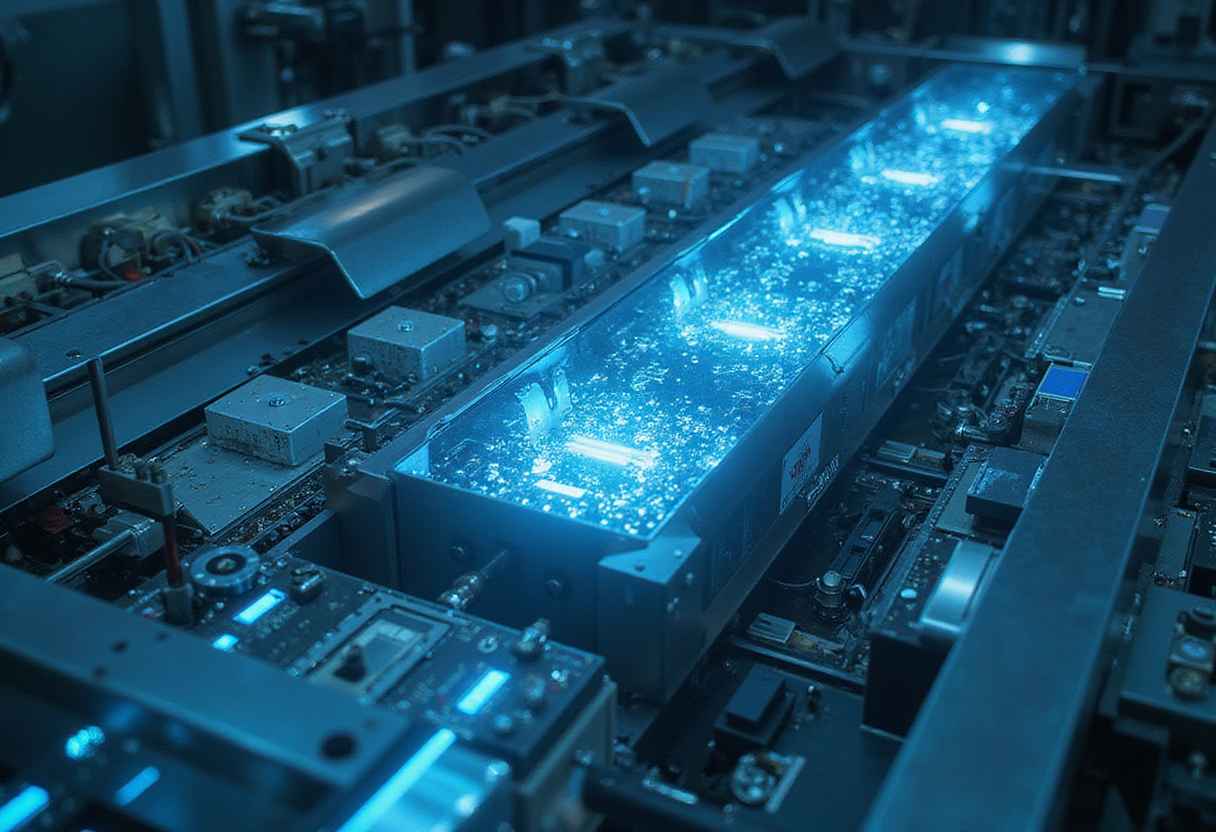
Researchers in China and the US have raised the superconducting critical temperature of niobium diselenide (NbSe2) by up to 5.4% — not by chemical doping, pressure or intense light, but by placing the material inside a resonant cavity that amplifies quantum vacuum fluctuations. The team, led by Changgan Zeng and Guanghui Cheng at the University of Science and Technology of China (USTC), calls the approach "vacuumtronics," and it marks the first experimental demonstration that vacuum fluctuations can modulate superconductivity in a bulk material.
The scale of the effect is modest in absolute terms, but the mechanism is what matters for R&D managers watching superconducting circuit and quantum sensor portfolios: the tuning is non-invasive and requires no energy input. The cavity is dark. No light shines on the sample, and nothing is pumped into it. "Instead, the effect arises from the ever-present electromagnetic fluctuations of the quantum vacuum," Cheng said.
How the experiment worked
In quantum electrodynamics, a vacuum hosts fluctuating electromagnetic fields in which pairs of virtual particles continuously appear and annihilate. These fluctuations are thought to drive phenomena such as the Lamb shift, spontaneous emission and the Casimir effect. They are, however, extremely weak on their own and produce little measurable change in macroscopic quantum states. Resonant cavities can amplify them by a factor of 100 or more, and such enhanced vacuum fields have already been used to modify chemical reactivity, topological states and conductivity in prior work.
The USTC team partially embedded a layered NbSe2 flake inside a specially designed near-terahertz split-ring resonator — the "dark cavity." They then measured resistance as a function of temperature, comparing regions of the same flake inside and outside the cavity. Using a single flake for both conditions is a meaningful control: it removes sample-to-sample variability as an explanation. The regions inside the cavity showed a critical temperature up to 5.4% higher than those outside. The researchers also report substantial increases in the critical current and critical magnetic field near Tc.
Cheng acknowledged the central experimental risk — that the signal could stem from sample inhomogeneity, strain or fabrication artifacts rather than genuine vacuum-fluctuation effects. He said the team invested considerable effort in control experiments to rule these out. The results are measured, not projected; the theoretical explanation, by contrast, remains a hypothesis.
The theoretical account
Theorists Qingdong Jiang of Shanghai Jiao Tong University and Frank Wilczek of MIT built a Ginzburg–Landau model of the effect. In their picture, the superconducting state exchanges virtual photons with the dark cavity, lowering the state's energy and thereby strengthening superconductivity. When the characteristic energy of the cavity mode matches the low-energy superconducting fluctuations, the device shows resonant enhancement — producing the peak in the superconductivity boost, Jiang explained.
"In most practical physics experiments, the vacuum serves merely as the passive stage on which such phenomena play out," Wilczek said. "Our work shows that the background itself can become an actor – engineered to strengthen superconductivity and reshape the behaviour of quantum matter."
What it means for device programs
For engineers working on superconducting circuits, quantum sensors and other cryogenic quantum devices, a tuning knob that changes Tc, critical current and critical field without altering the material's chemistry has obvious appeal: doping and strain engineering degrade other properties and complicate process control. Zeng framed the result as a proof of principle. "Although the temperature enhancement we demonstrated is modest, it is a proof-of-principle for what could become a broadly applicable approach," he said. "It could be relevant to superconducting circuits, quantum sensors and other quantum devices, where non-invasive control of superconducting properties would be particularly valuable. More broadly, such engineered vacuum fields could also be used to control states of matter other than superconductivity."
Two caveats deserve weight in any assessment. First, the demonstration covers one material, NbSe2, near its existing Tc — generalization to other superconductors is untested. Second, a 5.4% relative shift, while cleanly measured against an in-flake reference, does not itself change the operating-temperature economics of superconducting devices; the near-Tc gains in critical current and field may prove more practically relevant than the Tc shift itself.
The China–US team says it now aims to increase the size of the effect through improved cavity and material design, and to continue investigating the underlying microscopic mechanisms with its theorist collaborators.
via fusep.ustc.edu.cn (Original)
Filed under
- superconductivity
- quantum-vacuum
- cavity-qed
- quantum-materials
More from Rebecca Stone
Show full bio
Market editor covering marketplaces and e-commerce at Hypothesis Wire.
80 articles
References
- Infleqtion Expands Superstaq Reach Across Three DOE Labs
- Femtosecond Spectroscopy Settles WSe₂ Exciton Debate
- Applied Voltage Switches Exciton Transport in 2D Perovskite-WS2 Device
- NSF Commits $100M to National Quantum and Nanotechnology Infrastructure
- Montana Instruments cryostat cools to 4 K in under an hour