Proceedings · Session S-456 · filed November 18, 2026
AI & Emerging Tech in R&DSession paper
Osmo’s AI smell model claims human parity; evidence remains thin
Osmo says its AI scent model beat in-house perfumers in one company trial, backed by $8.5 million from the Gates Foundation and a dataset of 800 million scent tokens.
By Sophie Lindqvist5 min read944 words
Summary
- Osmo reports more than 10 million human labels and 800 million scent tokens.
- The Gates Foundation provided a $5 million launch investment and a $3.5 million insect-control grant.
- Osmo cites about 30 experienced sniffers near Newark Airport and about 70 trained labelers in the US and overseas.
- Osmo says its model matched an average person and a junior perfume designer, then beat in-house perfumers at an unnamed consumer-goods company.
- Michael Schmuker and colleagues open-sourced a reverse-engineered version of Osmo’s 2023 model.
Osmo has received $8.5 million from the Gates Foundation: a $5 million investment at launch and a $3.5 million grant for insect-repellent research, according to the company.
At a lab near Newark Airport in New Jersey, about 30 experienced sniffers are working through what the company describes as every odor on Earth. They record notes such as “nutty,” “peachy” and “marine,” then cross-reference them with chemical analysis to train a model Osmo claims is the world’s first foundation model for smell.
Founder Alex Wiltschko, who spun out the company from his work at Google Brain in 2023, says the aim is “to give computers a sense of smell.” No independent validation accompanies either the first-model designation or the performance claims.
Wiltschko describes scent as a chemical language shared across species and says it can summon durable memories, including a street smell that recalls high school. That premise defines the ambition but does not establish technical performance.
What does “human-level olfaction” mean?
Osmo says its model reached human-level olfactory intelligence during the past few months. The company defines that endpoint as average-person performance at detecting and discriminating odors and the work of a junior perfume designer at creating them.
Neither claim comes with a disclosed panel size, odor-set size, scoring protocol, statistical uncertainty or independent replication, limiting comparisons with established laboratory validation and procurement criteria.
Osmo also says its model outperformed in-house perfumers last month at one of the world’s largest consumer goods companies. Neither the employer, products, number of fragrances nor evaluation design was identified.
Wiltschko presents airport threat detection and disease diagnosis as eventual uses, not demonstrated deployments.
What is in the training dataset?
Before Osmo, existing databases contained fewer than 200,000 human smell descriptions, by Wiltschko’s count. He identifies costly chemical sensors and fragrance-industry secrecy as constraints on data collection.
Osmo reports an own dataset of more than 10 million human labels and 800 million scent tokens describing the molecules and concentrations in specific odors. About 70 trained labelers in the US and overseas sniff materials and write standardized fragrance terms.
Spectrometers and other chemical sensors run around the clock to characterize fruit, flowers, pantry staples and organs. The process combines human judgments with instrument measurements rather than relying on either alone.
Wiltschko says the work found substantial overlap between the scent tokens of a newborn baby and a fresh plate of cooked Barilla spaghetti. He uses the comparison to argue that molecular proportions, much like word order, can alter perceived odor.
Can the model formulate and print fragrances?
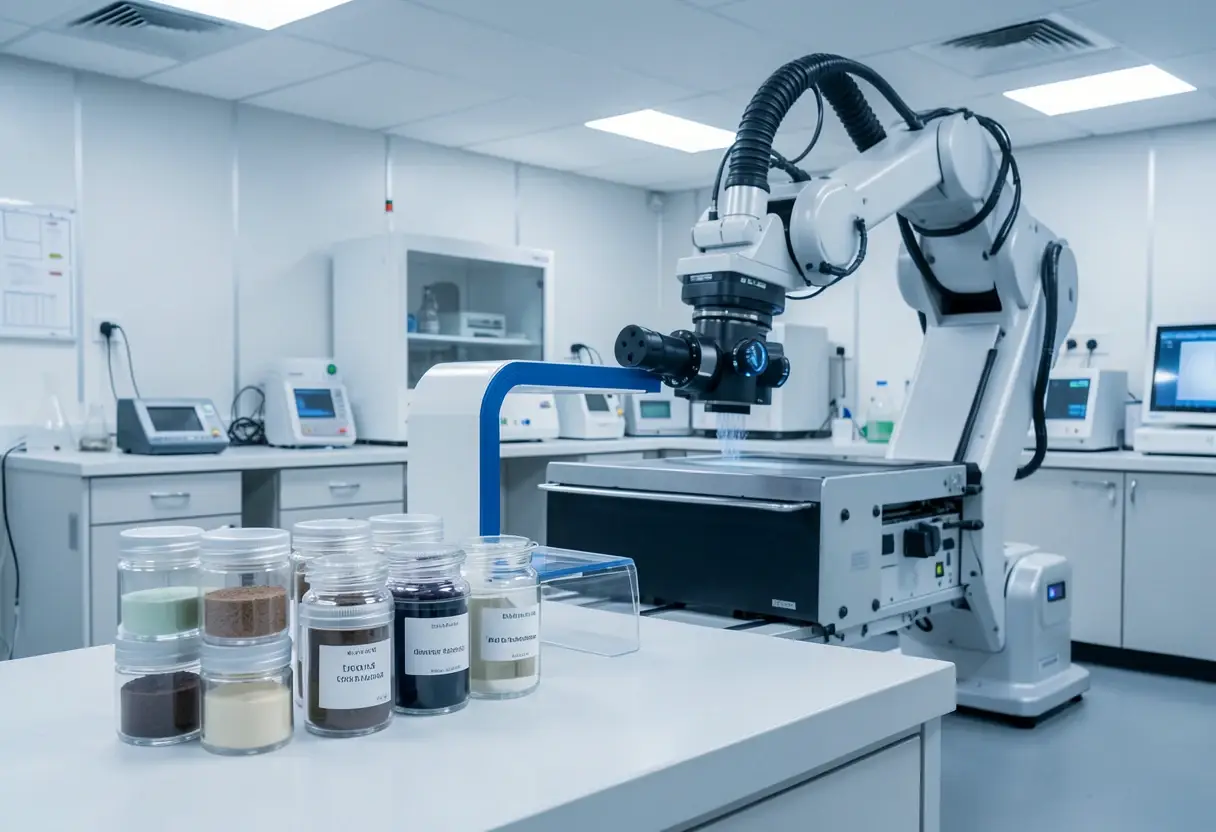
Osmo uses a smell-printing robot the size of a school bus to mix ingredients under precise formulas. It produces samples for company research and fragrances for paying customers, while the model can propose formulations from a ChatGPT-style text prompt.
At the Web Summit in Lisbon, a demonstration requested a Portuguese custard-tart fragrance aimed at men aged 18 to 23. After several minutes, the model returned three profiles—creamy, coconutty and fruity—and the molecules needed for each.
Ordering the resulting “L’Eau de Custard” would have made it ready about one week later. The demonstration report provides no prompt-set size, comparison baseline, trial count or independent perfumer review.
Where has the technology been used?
Osmo says it has helped create retail fragrances for companies including Procter & Gamble. Its technology also supports StockX, the online clothing marketplace, in detecting counterfeit sneakers by comparing chemical differences in shoe materials.
The Gates Foundation grant funded assessment of molecules intended to repel disease-carrying insects. Osmo says it identified eight substances more repellent than DEET. No species, assay, dose, sample size or third-party confirmation was reported.
Company-described engagements indicate commercial use beyond the laboratory, but the available details do not define the Procter & Gamble brief, the perfumer comparison or the insect assay.
What do outside specialists say?
Avery Gilbert, a smell scientist and author of What the Nose Knows, says some Osmo marketing claims remain undocumented. He notes that patent filings still rely on human sensory panels and perfumers rather than AI.
Gilbert wrote in March that “This heavy reliance on human sensory judgments” seemed odd for a company premised on AI. Osmo did not respond to detailed questions before publication.
Michael Schmuker, a former University of Hertfordshire professor of neural computation and former Osmo consultant, calls the technology an achievement. He and colleagues created an open-source, reverse-engineered version of Osmo’s 2023 model, although it lacks the data the company has collected since.
Schmuker identifies context as a limit that a large molecular dataset cannot remove. The smells of Camembert and used nappies can partly arise from the same molecule, but context separates the associations people assign to them.
In a controlled fragrance laboratory, context may matter less. On a food-production line, judging spoilage would still require contextual interpretation rather than molecule matching alone.
Schmuker says sensors must improve alongside the models, with medical diagnostics the largest prize. Wiltschko imagines smell as an olfactive channel for AI world models, including systems that flag spoiled food or detect tumors as trained dogs do in pilot studies.
Wiltschko says earlier attempts to tackle such goals directly have failed because the work is expensive and difficult. He calls Osmo’s shared model a foundation built before application-specific expeditions, shifting near-term risk toward continued sensor and model improvement rather than one decisive clinical test.
For R&D managers, the next test is whether Osmo can disclose benchmark protocols and support independent replication before its human-parity and medical claims carry procurement or clinical weight.
via prnewswire.com (Original)
Filed under
- ai-olfaction
- foundation-models
- scent-technology
- ai-validation
- fragrance-formulation
More from Sophie Lindqvist
Show full bio
Correspondent covering money, funding and market shifts around research and development at Hypothesis Wire.
242 articles
References
- 10-Pharma Consortium Pooled 2.6 Billion Data Points — and Won
- Anthropic's safety classifiers add 24% to compute costs — and still fail
- Isomorphic Labs predicts AI-designed drugs as $5bn raise talks surface
- OpenAI's BioBasicsBench: top model hits 66.7% on wet-lab data reading
- OSTP Director Defends Plan to Overhaul Federal Research Funding