Proceedings · Session S-966 · filed November 4, 2026
AI & Emerging Tech in R&DSession paper
OpenAI says GPT-6 Astra designed a working 'Codex pet' hardware prototype
OpenAI says GPT-6 Astra designed a talking 'Codex pet' — enclosure, PCB, firmware — in under a week, though factory manufacturing took several rounds to get right.
By Rebecca Stone4 min read762 words
Summary
- OpenAI stated Nov. 3 that GPT-6 Astra designed a complete hardware prototype in a side project lasting under a week
- A contract manufacturer built a small prototype batch in under a month, but manufacturing required several rounds with the factory
- NextPCB's September test: Astra routed a board in ~12 minutes using Freerouting, but drew only three trace segments in an hour when restricted to KiCad's interface
- Researcher Justin Lin said it was his first time taking a board from bare to assembled
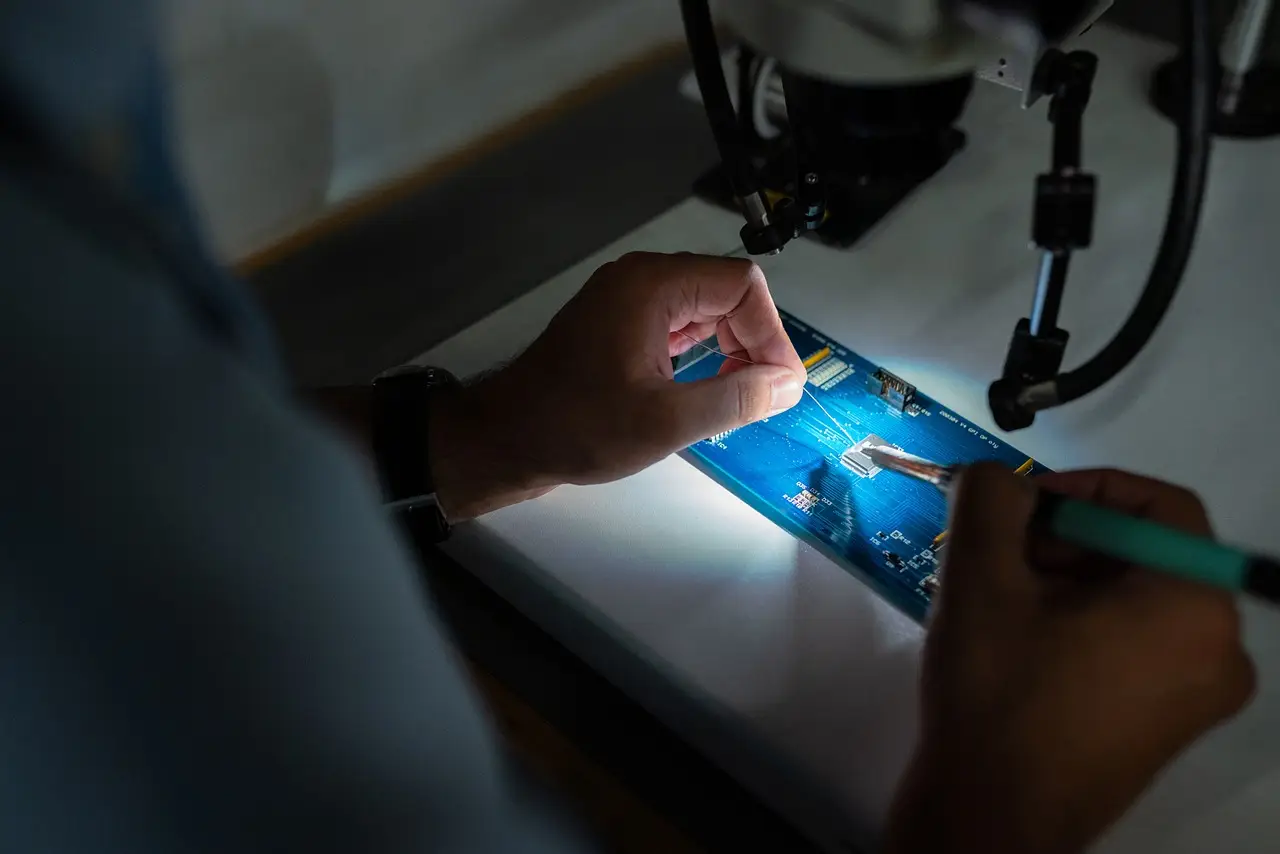
OpenAI stated on Nov. 3 that GPT-6 Astra designed a complete hardware prototype — enclosure, printed circuit board, firmware and software — for a push-to-talk desk device that lets a researcher talk to his coding agents without opening a laptop. Two OpenAI team members spent less than a week on the side project, and a contract manufacturer delivered a small batch of prototypes in under a month.
The claim deserves scrutiny on one point OpenAI itself concedes: the path from design files to assembled hardware was not clean. "Obviously, took a few rounds with the factory, but this is what came back," said Justin Lin, the OpenAI researcher behind the device, in a video about the project. The company says the team generated the designs without direct human edits, but needed several rounds of review and iteration to make them manufacturable.
What did the model actually do?
According to OpenAI, Astra's contribution covered the full engineering chain:
- Defined the functional requirements for the device
- Designed the case and the internal structures that hold the components
- Selected the electrical components and placed and connected them on a printed circuit board sized to fit the enclosure
- Designed the user interface and generated the firmware and software integrations linking the device to Codex, OpenAI's coding agent platform
OpenAI labels the project images "TamaGPT device experiments" and calls the result a "test device" — language that separates a working prototype from a product. The company credits Astra with the design work and cites keyboard maker Work Louder, games and toys as visual references.
Lin, who describes the device as a "Codex pet," built it to demonstrate Astra's computer-use skills alongside what he called "some of the new physical engineering capabilities." The motivation was partly practical: the growing habit of speaking to agents by voice still carries interface friction. "I really, really don't like having to like open my laptop and like whisper my sweet nothings into Codex," he said. He wanted a companion device living on a small display, with a push-to-talk button.
How much engineering skill did the human need?
Notably, Lin said it was his first time taking a circuit board from bare to assembled, a process he called "super daunting." His account of the workflow is short: "I told Chat what I wanted, gave it some plans, and it designed the board."
That framing — a first-time board builder going from plans to assembled hardware — is the experiment's strongest signal for R&D managers watching automation of engineering labor. It also carries its own limit: the claim rests on OpenAI's own account of an internal side project, with no independent verification and no disclosed count of prototypes or iteration rounds.
The prototype sits within a broader OpenAI hardware push that includes a design collaboration with former Apple design chief Jony Ive and his firm LoveFrom.
What does an independent test show?
A separate September test by circuit-board manufacturer NextPCB offers a more granular picture of how the model handles electronics work — and where the limits sit.
Hubert Hu, NextPCB's head of technology, gave Astra a board with components already placed. Astra produced a routing result — the copper connections between components — in about 12 minutes. It did so by passing the design to Freerouting, an open-source autorouter (software that computes those connections automatically), then importing the result back into KiCad, the open-source electronics design suite.
Restricted to KiCad's own interface, the same model managed only three short trace segments in an hour before Hu stopped the run. NextPCB's assessment is precise about the division of labor: "Freerouting performed the core routing computation. Astra orchestrated the workflow."
What should R&D teams take from this?
The two data points bracket the current capability honestly. Astra can coordinate a full design workflow — requirements, mechanical design, component selection, firmware — well enough that a novice produced factory-ready files inside a week. On the specialized computational task of routing, the model functioned as an orchestrator over dedicated tools rather than as a substitute for them, and it stalled when confined to a general-purpose interface.
For teams weighing model-assisted engineering, the pattern matches a tooling decision, not a headcount one: the measurable speedup came from competent orchestration of existing software, while manufacturability still required human review loops with the factory. OpenAI has not said whether the Codex pet will move beyond a test device, but the company's willingness to publish iteration counts alongside its claims suggests more hardware demonstrations are coming.
via openai.com (Original)
Filed under
- gpt-6-astra
- ai-assisted-engineering
- hardware-prototyping
- pcb-design
- coding-agents
More from Rebecca Stone
Show full bio
Market editor covering regulation, policy and their impact on research and development at Hypothesis Wire.
228 articles
References
- OpenAI and Synopsys to Build Specialized AI Model for Chip Design
- OpenAI shifts up to 10% of compute to safety, pauses model training
- Why working prototypes stall before the market: medtech's lesson
- GPT-6 Astra scores 62.7% on interactive reasoning benchmark
- OpenAI claims three AI advances in math, computing and physics