Proceedings · Session S-154 · filed October 22, 2026
AI & Emerging Tech in R&DSession paper
Nvidia and UW Unveil Open-Source Protein Design Model With 10x Throughput
Nvidia and UW's IPD released RFD4-Proteina, an open-source protein design model claiming five- to 10-fold higher success rates and speed, funded in part by a $25.7M Gates grant.
By Rebecca Stone4 min read776 words
Summary
- RFD4-Proteina claims five- to 10-fold higher design success rates and 5-10x faster generation than prior models.
- The model is open-source under BSD-3 and available via nine partners including Google Cloud, OpenAI and Hugging Face.
- The Gates Foundation committed $25,748,619 (grant INV-092109, dated November 2025) toward the work.
- Lab tests covered four benchmark suites: protein binding, small-molecule binding, enzyme scaffolding and DNA binding.
- IPD director David Baker shared the 2024 Nobel Prize in Chemistry for computational protein design.
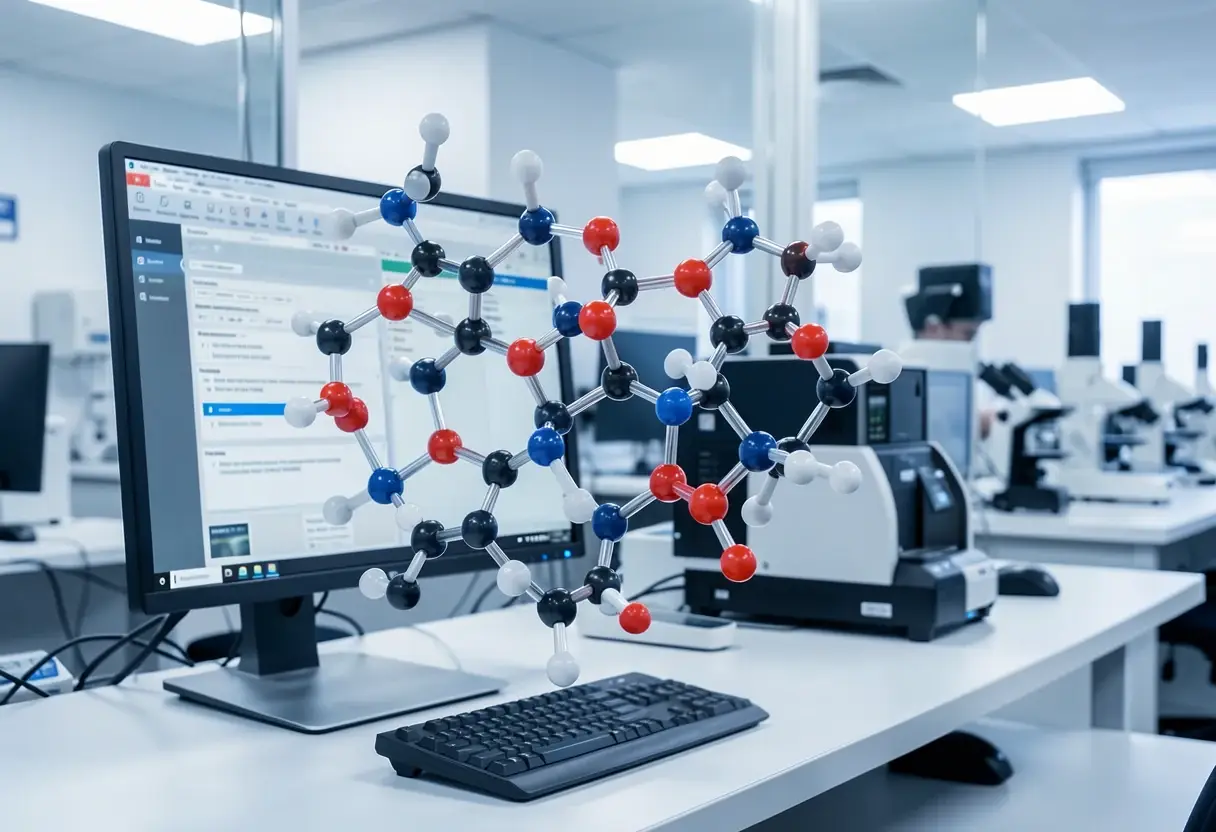
Nvidia and the University of Washington's Institute for Protein Design (IPD) have released RFD4-Proteina, an open-source generative protein design model that its developers say achieves five-fold to 10-fold higher design success rates and generates protein candidates five to 10 times faster than previous models.
The model is immediately available under a Berkeley Software Distribution (BSD-3) open-source license. It runs on Nvidia's BioNeMo, the company's AI platform for chemistry and biology, and combines programmable protein design with search capabilities. Researchers can supply molecular inputs, constraints and scoring objectives, then search and refine the generated designs — a workflow intended to produce candidate proteins matched to a target function, such as interrupting a disease process or serving as a diagnostic detection reagent.
The performance claims come with benchmark detail, though the data so far is vendor-reported. Nvidia said lab bench tests showed RFD4-Proteina achieved higher computational design success rates and generation throughput than evaluated baselines across four benchmark suites: protein binding, small-molecule binding, enzyme scaffolding and DNA binding. The company did not publish sample sizes or absolute success rates alongside the announcement, so the five- to 10-fold figures should be read as developer claims pending independent replication.
What does the model actually do differently?
RFD4-Proteina refines a protein's sequence and structure concurrently with the structures of interacting molecules, so a change in one component propagates to the others in the same design step. Its name traces its lineage: "RFD" comes from the IPD's RosettaFold Diffusion, a guided diffusion model (a generative method that starts from noise and progressively shapes it toward a valid structure) for generating new proteins, while "Proteina" comes from Nvidia's Proteina-Complexa, a generative model for protein binder design. Proteina-Complexa combines inference-time optimization with a pretrained flow-based generative model built on Nvidia's La-Proteina model for atomistic protein design.
At IPD, early users reported gains in both efficacy and speed on real design problems. Meg Lunn-Halbert, a UW PhD candidate in biochemistry and in biological physics, structure and design, said: "We were able to precisely control what types of glycans (sugars important for immune-system recognition) are attached to proteins in ways past models haven't been able to achieve, and to do so in under just a week rather than months."
Seth Woodbury, a UW bioengineering predoctoral candidate and National Science Foundation fellow, reported a comparable compression of his design cycle: "In just a few days we designed a pesticide-degrading enzyme that performs many fold better than my previous best, which took months to design."
How can labs access it?
Distribution runs through a broad partner network rather than a single vendor channel. RFD4-Proteina is available through Amazon Bio Discovery, Anthropic's Claude Science, Benchling, Databricks, Google Cloud, Hugging Face, Nebius, OpenAI and Tamarind Bio, allowing integration into agent, cloud and scientific computing workflows. For R&D managers weighing platform lock-in, the BSD-3 license and multi-cloud availability mean the model can be pulled into existing infrastructure without exclusive commitments.
Who built it, and who paid?
IPD's project leads were three UW PhD students — Nathaniel Corley, Maxwell Kazman and Rafi Brent — together with Kieran Didi, a visiting student from the University of Oxford. Funding came from the Howard Hughes Medical Institute, the Gates Foundation (grant INV-092109), the Grantham Foundation, the Fund for Science and Technology, Schmidt Sciences, the OpenFold consortium (part of OMSF) and Rosetta Commons. The Gates Foundation's website lists a commitment of $25,748,619 through a grant dated November 2025. UW also credited a computational grant from the Jen-Hsun and Lori Huang Foundation as critical to the model's development.
The IPD is directed by Nobel laureate David Baker, PhD, professor of biochemistry at UW Medicine and a Howard Hughes Medical Institute Investigator. Baker shared the 2024 Nobel Prize in Chemistry for computational protein design with Sir Demis Hassabis and John Jumper.
"We are moving from an era of discovering the proteins nature has made to one in which we can design entirely new ones," Baker said in a statement. "RFD4-Proteina expands what scientists can create, from proteins that could advance drug discovery to enzymes that break down pesticides."
Baker projected broader applications: better medicines, new methods of breaking down polymers and new ways of making bioplastics — projections that remain to be tested, in contrast to the benchmark results already measured.
With the model now open and reachable through nine distribution partners, the near-term test will be whether outside laboratories reproduce IPD's reported success rates on independent design problems.
via ipd.uw.edu (Original)
Filed under
- protein-design
- generative-ai
- open-source-models
- drug-discovery
- nvidia-bionemo
More from Rebecca Stone
Show full bio
Market editor covering regulation, policy and their impact on research and development at Hypothesis Wire.
219 articles
References
- AbbVie, Takeda Join Ginkgo-Apheris Antibody Developability Push
- Talus Bio Releases Structure-Free AI Model for Disordered Proteome
- Takara Bio USA Pairs NGS Library Prep with SPT Labtech Firefly
- WHO's 15-Partner mRNA Programme Tests the Industry's Manufacturing Playbook
- Baylor Team Couples Proteomics and AI to Degrade VAV1