Proceedings · Session S-509 · filed October 14, 2026
Lab Technology & MethodsSession paper
Deep Eutectic Solvents Boost Enzyme Half-Lives Ninefold in Biocatalysis
A Xiamen University review finds deep eutectic solvents extended lipase half-life from 1 to over 9 hours and flipped arylpropanone stereochemistry from S to R.
By Sophie Lindqvist3 min read562 words
Summary
- Candida rugosa lipase half-life rose from 1 hour to more than 9 hours in deep eutectic solvents.
- Humicola insolens cutinase half-life increased from 22 minutes to 62 minutes via hydrogen bond acceptor choice.
- Baker's yeast converted arylpropanones to the S enantiomer in water but predominantly the R version in DES.
- The review is by Xiamen University's Hou, Meng, Chen, Yuan and Wang.
- Solvent-based thermostability tuning is faster and cheaper than protein engineering, the authors write.
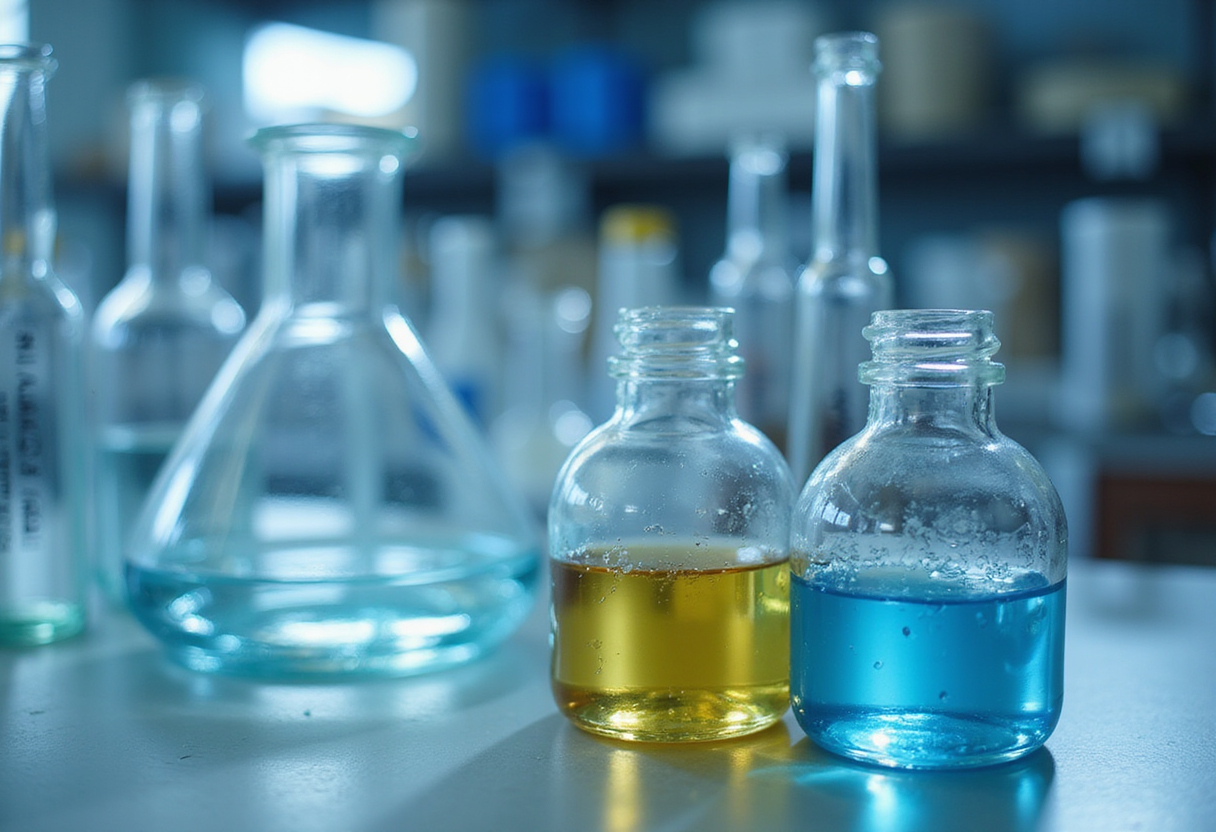
Switching a biocatalysis reaction into deep eutectic solvents (DES) extended the half-life of Candida rugosa lipase from one hour to more than nine, according to a literature review by Xiamen University scientists published this year. For process chemists, the finding signals that solvent choice has moved from formulation detail to a first-order bioprocessing parameter — one that can change titer, productivity, thermostability and even product stereochemistry without a single round of protein engineering.
The review, authored by student Yuxuan Hou and professors Jinyu Meng, PhD; Binghui Chen, PhD; Jifeng Yuan, PhD; and Shizhen Wang, PhD, synthesizes the accumulating evidence on DES in biocatalysis as biomanufacturers slowly shift from aqueous systems toward non-aqueous operation.
What did the review measure?
The authors report several concrete outcomes from cited studies:
- Candida rugosa lipase half-life rose from 1 hour to more than 9 hours in DES, with the hydrogen bond donor identified as the key determinant.
- Humicola insolens cutinase half-life increased from 22 minutes to 62 minutes, driven by the hydrogen bond acceptor.
- Residual activity of cellulase and pectinase rose and then fell as water quantities increased — a non-monotonic relationship.
- In a hydrogenase/TiO2 photocatalytic system, increasing solvent quantity reduced dioxygen transport, while increasing water content raised activity.
The thermostability gains matter for budget planning: modulating stability through the solvent, rather than through bioengineering of the enzyme, is faster and cheaper, the authors write.
Why is solvent a process parameter, not just a medium?
"DES composition and water content shape the enzyme-specific microenvironment and thereby affect catalytic performance," Hou and colleagues note. Changing composition alters the DES hydrogen-bond network, viscosity, diffusivity, polarity and solvent distribution around the protein surface.
The aqueous fraction adds a further layer. "The aqueous fraction can affect the interactions between DES components and proteins, and alter hydration, thereby further modulating enzyme thermostability," the scientists point out. "Accumulating evidence indicates that DES can enhance enzyme thermostability while preserving catalytic activity."
Can a solvent flip stereochemistry?
Yes — and this is where quality control risk enters. The review cites a study in which baker's yeast converted arylpropanones, high-value intermediates used to manufacture some active pharmaceutical ingredients. With water as the solvent, conversion produced predominantly the "S" enantiomer. In DES, the same conversion ran predominantly to the "R" version.
That solvent-modulated selectivity gives process developers unusual flexibility — one organism, two stereochemical outcomes, no enzyme redesign. It also means quality teams must control solvent composition tightly, because the same lever that tunes selectivity can silently shift product profile.
What are the limits of the evidence?
The review is a synthesis of prior literature, not a new controlled trial, and the authors themselves flag the central gap: data on enzyme behavior across different solvents remain sparse. The headline half-life numbers come from individual cited studies of specific enzyme–solvent pairs, and the field has not yet mapped how broadly the effects generalize across enzyme classes or DES compositions.
For R&D managers weighing a DES program, the practical read is that solvent screening deserves a place beside pH, temperature and substrate concentration in design-of-experiments work — with explicit controls for water content, since it independently modulates activity and stability. Whether the ninefold half-life gains seen in lipase and cutinase translate to other enzymes will depend on systematic screening data the field has yet to generate.
via sciencedirect.com (Original)
Filed under
- biocatalysis
- deep-eutectic-solvents
- enzyme-stability
- process-chemistry
- bioprocessing
More from Sophie Lindqvist
Show full bio
Correspondent covering money, funding and market shifts around research and development at Hypothesis Wire.
166 articles
References
- DOE Names Funding Selections Under MACRO Algae Conversion Program
- Kagan and Soai Win 2026 Chemistry Nobel for Mirror-Molecule Catalysis
- Label-Free Electrical Signals Could Give Bioprocess Engineers Earlier Warnings of Failing Cultures
- 20,000 Simulated Data Points Plus 65 Bioreactor Runs: A Case for Multi-Fidelity ML in Bioprocessing
- Membrane hydrocarbon separation reaches 50-metre refinery trials